
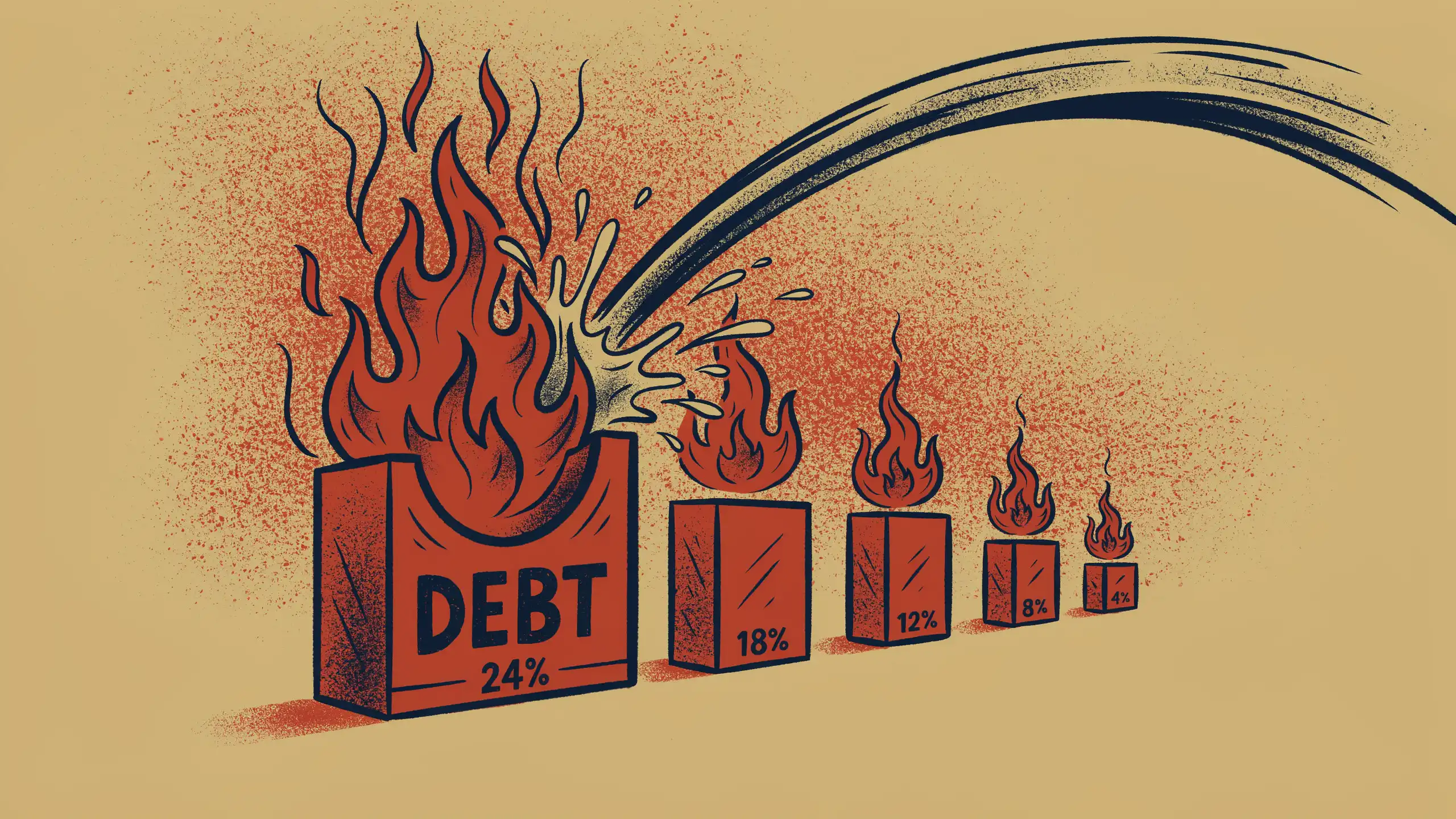

Every extra dollar you put toward a debt saves interest at that debt’s rate, however big or small the balance. That’s why the debt avalanche, which targets your highest rate first, costs less than the debt snowball, which starts with the smallest balance. Pay every minimum, then send each extra dollar to your highest-rate debt until it’s gone.
Plenty of popular advice says the opposite. When Yale economist James Choi reviewed 50 top personal finance books, roughly half of those that covered payoff order said to start with the smallest balance.
The math doesn’t care which balance is smallest. Every dollar on a 25% credit card costs about 2 cents a month in interest, and every dollar on a 7% car loan costs about half a cent. An extra dollar sent to the card instead of the loan saves more than three times as much, whatever either balance is.
Take $9,000 of card debt at 25%, a $5,000 car loan at 7%, and an $800 card balance at 18%, with $700 a month to cover all three. By our math, the snowball, which pays every minimum and aims the rest at the smallest balance first, costs about $3,900 in interest. The avalanche costs about $3,500, and the gap grows as your rates spread further apart.
The snowball’s real case is motivation. A Kellogg School of Management study of nearly 6,000 debt settlement clients found that the number of accounts people closed predicted who finished the program better than the dollars they’d repaid. If an early win keeps you going, take one, then switch to the avalanche. In the example, clearing the $800 card first costs about $100 more than starting with the 25% card, roughly a quarter of what the full snowball adds.
Rank by the rate you’ll actually pay. A deferred-interest promotion on a store card charges no interest for now. But the Consumer Financial Protection Bureau warns that if the balance isn’t paid off when the promotion ends, you can owe interest back to the purchase date. Clear it before that deadline, even ahead of a higher rate.
When a debt hits zero, keep your monthly total the same and move its payment to the next rate down. Every payoff then speeds up the one after it.

Editorial & Advertiser Disclosure: The editorial content on this page is not provided, commissioned, reviewed, approved, or otherwise endorsed by any advertiser. Opinions expressed here are ours alone, not those of any advertiser. The offers that appear on this site are from companies that compensate us. That compensation may influence which products we cover and where and how they appear on a page – including the order in which they appear – but it does not influence our evaluations, ratings, or opinions. We do not include every company or offer available in the marketplace.
Related: