
Open your young child a savings account that pays interest on every dollar, then add a debit card when they start spending. Capital One offers both with no monthly fee, and its MONEY Teen Checking stays fee-free after 18. Pay for an app like Greenlight only if you’ll track chores and pay allowance in it.
The FDIC puts the national average savings rate at 0.39%, while Capital One’s kids savings account pays 2.50%. On birthday and allowance money, the account you open decides whether your child earns enough interest to notice.
Each pick fits a stage or a need: a savings account for a young child, a debit card with parental controls once they spend on their own, and a teen account that can take a paycheck. Fees, interest on a small balance, the controls you get, and what happens at 18 decided each pick.
Savings accounts for young kids
Check the age limit on a savings account for kids before you open one, since some take only younger children.
Best for steady savers: Alliant Kids Savings

Alliant pays 3.01% only in months the balance averages $100 or more, so choose it for a child 12 or younger who’ll keep that much saved.
- What Sets It Apart: The same rate Alliant pays every member on High-Rate Savings, plus up to 19 named goal accounts at that rate
- APY: 3.01% in months the average daily balance is $100 or more; no interest below $100
- Features: Recurring allowance transfers; the child’s own login, with a parent’s view once the child grants it; mobile check deposit; a free Alliant Savings ATM card; NCUA insurance
- Monthly Fee: $0, with free paper statements
- Minimum Deposit: $5, which Alliant pays
- Cost: $10 inactivity fee when an account holding $200 or less goes 12 months with no deposits or withdrawals besides interest
- Eligibility: Children 12 and younger, with a parent, grandparent, or guardian co-owner who’s an Alliant member, a membership anyone can apply for through the Alliant Credit Union Foundation
- Pros: Alliant pays the $5 to join and the $5 to open; no monthly fee; named goal accounts; stays open as savings at 13
- Cons: No interest under $100; no branches; $10 inactivity fee on a small idle balance; parent view needs the child’s go-ahead
For more information, read our full Alliant Kids Savings Review.
Best for small balances: Capital One Kids Savings Account
Any child under 18 can have one, it pays interest on every dollar, and it stays open after 18, so it suits a teen or a child with less than $100 saved.
- What Sets It Apart: One rate at any balance, with no tier a child must reach first
- APY: 2.50% on every balance, variable
- Features: Your child’s own sign-in to see the balance and deposit checks; transfers by your child only from 13, and only with Capital One MONEY Teen Checking; Automatic Savings Plan; FDIC insured to $250,000
- Monthly Fee: $0, with no minimum balance
- Minimum Deposit: $0
- Cost: No fee for electronic transfers; $10 per cashier’s check
- Eligibility: A child under 18 and a parent or legal guardian as co-owners; U.S. citizens or permanent residents with a U.S. address
- Pros: Interest on small balances; your own sign-in for transfers and automatic deposits; separate accounts per child or goal
- Cons: 2.50% is less than 360 Performance Savings’ 3.20%; withdrawals only online, by phone, or at a branch; transfers in from other banks usually aren’t available until the fourth business day; your child can withdraw or close it at 18
For more information, read our full Capital One Kids Savings Account Review.
Debit cards with parental controls
Choose a debit card for kids by the controls you’ll actually use, from an alert on each purchase to limits on where your child can spend.
Best if you bank elsewhere: Capital One MONEY Teen Checking
Families outside Chase can link it to their checking at any bank, and their child can keep the account and its debit card, still fee-free, after 18.
- What Sets It Apart: Kids can join at 6, it stays fee-free after 18, and parents needn’t bank at Capital One
- APY: 0.10% on every balance, compounded monthly
- Features: Parent alerts, card lock, and spending limits; allowance and savings goals; 70,000+ fee-free ATMs; cash at Walgreens, CVS, and other stores through the app; Zelle from 13; FDIC insured
- Monthly Fee: $0, including after 18
- Minimum Deposit: $0
- Cost: No overdraft fee, since a purchase over the balance can be declined; no fee at Capital One, Allpoint, or MoneyPass ATMs, though other ATM owners may charge; no transfer fee
- Eligibility: Kids 6 to 17 with one parent or legal guardian as joint owner, who links a Capital One account or checking at another U.S. bank; one account per child
- Pros: No fees at any age; separate parent and child sign-ins; cash deposits at stores; stays open after 18
- Cons: Opened online only, with no checks; under-13s can’t use Zelle or add cash themselves; savings goals earn only 0.10%
For more information, read our full Capital One MONEY Teen Checking Review.
Best for Chase families: Chase First Banking

It’s free for Chase checking customers, who own it outright and can cap their child’s spending by store and by amount.
- What Sets It Apart: Spending limits by store and amount; scheduled allowance and paid chores
- Features: Debit card for ages 6 to 17; $400 daily purchase and $100 daily ATM limits; savings goals; money requests; up to five accounts per parent
- Monthly Fee: $0
- Cost: $3 per non-Chase ATM withdrawal in the U.S. and $5 abroad; 3% on transactions in another currency
- Eligibility: A parent’s qualifying Chase checking account
- Pros: Free; detailed parental controls; kids use the Chase Mobile app
- Cons: Chase Total Checking costs $15 a month unless you meet a waiver; no cash, check, or direct deposits; no payment apps; no interest
For more information, read our full Chase First Banking Review.
Best chore & allowance app: Greenlight
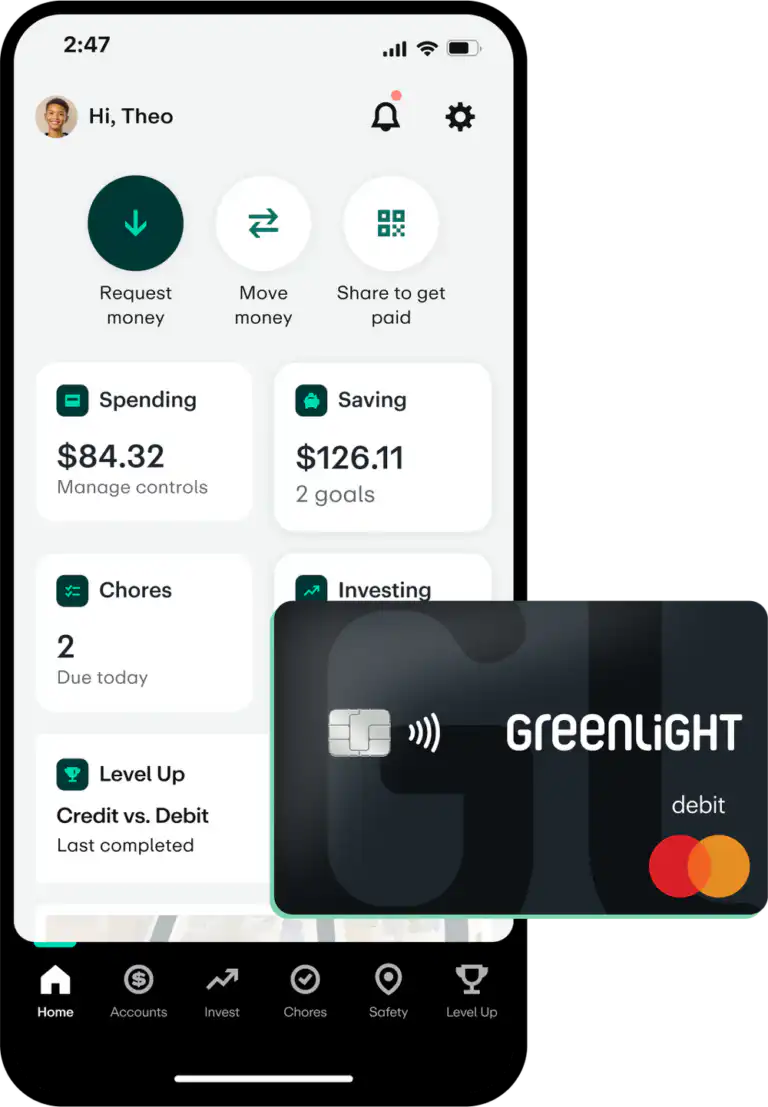
Its monthly fee covers chore tracking, allowance, and a savings reward for up to five kids. Pay it only if your family will use those tools every week.
- What Sets It Apart: Greenlight pays a reward on kids’ savings itself, and Infinity adds crash detection and driving reports for teens
- APY: 2.00% a year on Core to 6.00% on Family Shield, on up to $5,000 per family; needs a linked bank account
- Rewards: 1% cash back on kids’ spending, paid monthly into savings, on Max and up
- Features: Chores and scheduled allowance; store and category blocks; real-time alerts; FDIC insurance through Community Federal Savings Bank
- Monthly Fee: $5.99 (Core), $10.98 (Max), $15.98 (Infinity), or $19.98 (Family Shield) for up to five kids; free with checking at some banks, such as U.S. Bank
- Cost: No Greenlight ATM fee; $0 to add money; no foreign transaction fee; $9.99 custom card
- Eligibility: No minimum age for kids
- Pros: Chores, allowance, and spending controls on the cheapest plan; One plan covers up to five kids; No Greenlight fees to add money, use ATMs, or spend abroad
- Cons: A monthly fee, unless your bank includes a Greenlight plan; Cash back and kids’ investing need the $10.98 Max plan; Savings rewards stop at $5,000 per family; ATM operators can still charge fees
For more information, read our full Greenlight Review.
Accounts for teens
Best for Chase families: Chase High School Checking
Chase families get a free teen account that takes a paycheck by direct deposit and sends money through Zelle, until it turns into Chase Total Checking at 19.
- What Sets It Apart: Chase’s 5,000 branches and 14,000-plus fee-free ATMs behind a teen account with no monthly fee
- Welcome Offer: $125 for your teen after 5 qualifying transactions within 60 days of enrolling; open with Chase’s offer code by January 27, 2027
- Features: Debit card that works in digital wallets; Zelle, direct deposit, mobile check deposits, and check writing; Account Alerts for you and your teen; Autosave to Chase Savings, fee-free for owners under 25; FDIC insured
- Monthly Fee: $0
- Cost: No overdraft fees, since Chase declines card purchases the balance can’t cover; $3 per withdrawal at non-Chase ATMs in the U.S. and $5 abroad, plus the owner’s fee; 3% foreign exchange fee
- Eligibility: Teens 13 to 17 at opening, co-owned by a parent or guardian with a linked, qualifying Chase checking account (Secure Banking, College, and First Checking don’t count); opens only in a branch
- Pros: No monthly or overdraft fees; paychecks, Zelle, and check deposits; about 5,000 branches
- Cons: The parent’s Chase checking can cost $15 a month; no parental spending controls; no interest; becomes Total Checking, with its fee, at 19
For more information, read our full Chase High School Checking Review.
Best without a co-owner: Wells Fargo Clear Access Banking

A 17-year-old can open it at a branch without an adult co-owner, and its monthly fee is waived until the owner turns 25, with no overdraft fees at any age.
- What Sets It Apart: Declines what the balance can’t cover instead of charging overdraft fees, at a bank with branches and more than 10,000 ATMs
- Features: Wells Fargo branches and ATMs that take cash deposits; FDIC insured; Zelle for owners 13 to 17, which an adult co-owner can switch off; mobile check deposit; Early Pay Day; a debit card you can turn off in the app
- Monthly Fee: $5, waived for primary owners 13 to 24 or with $250 a fee period in direct deposits or other electronic pay
- Minimum Deposit: $25
- Cost: No overdraft or decline fees; $0 at Wells Fargo ATMs, $3 at other U.S. ATMs, and $5 abroad; 3% on foreign purchases
- Eligibility: Ages 13 and up; 13 to 16 with an adult co-owner; anyone under 18 opens at a branch
- Pros: No overdraft fees; no monthly fee through age 24; Zelle for teens; branches and ATMs for cash
- Cons: No checks; no interest; few parent tools beyond co-ownership; a negative balance is still possible
For more information, read our full Wells Fargo Clear Access Banking Review.
Best for building credit: Step
Card use from age 16 can count toward a teen’s credit, since Step reports up to two years of it to the credit bureaus once they turn 18 and verify the account.
- What Sets It Apart: A secured credit card paid off automatically each month, whose record from age 16 can reach the credit bureaus at 18
- APY: 3.00% as a cash reward from Step, not interest, in months with Step Black ($500 in card spending or $300 in qualifying direct deposits a month, the teen’s or the sponsor’s)
- Rewards: 1% cash back on purchases with Step Black
- Features: Sponsors see activity in real time, freeze the card, and block merchants; 30,000 fee-free ATMs; FDIC insurance up to $250,000 through Evolve Bank & Trust
- Monthly Fee: $0
- Minimum Deposit: $0
- Cost: $3.95 per cash deposit after the first two; no overdraft fee; $5 per card replacement after the first two
- Eligibility: U.S. residents of any age; under 18, a sponsor with their own Step account
- Pros: Free credit reporting at 18; no interest, late fees, or overspending; free at 30,000 ATMs; real-time view for sponsors
- Cons: No earnings without Step Black; card use before 16 not reported; FDIC insurance covers Evolve, not Step; score claims count select users
For more information, read our full Step Review.
The right account changes with your child’s age, but there’s a free one for every stage. Start with a savings account that earns interest on whatever your child keeps, and add Capital One MONEY Teen Checking once they’re ready to spend on their own.
For money you want to invest in your child’s name rather than save, compare the best custodial accounts for kids.


Subscribe and we'll send you 101 Essential Money Tips to get you started.
The 101 money moves that matter most, from the foundations to protecting what you’ve built.
Advertiser Disclosure: Many or all of the offers that appear on this site are from companies that compensate us, and some companies pay for sponsored content. That compensation may influence which products we cover and where and how they appear on a page, including the order in which they appear. We do not include every company or offer available in the marketplace.