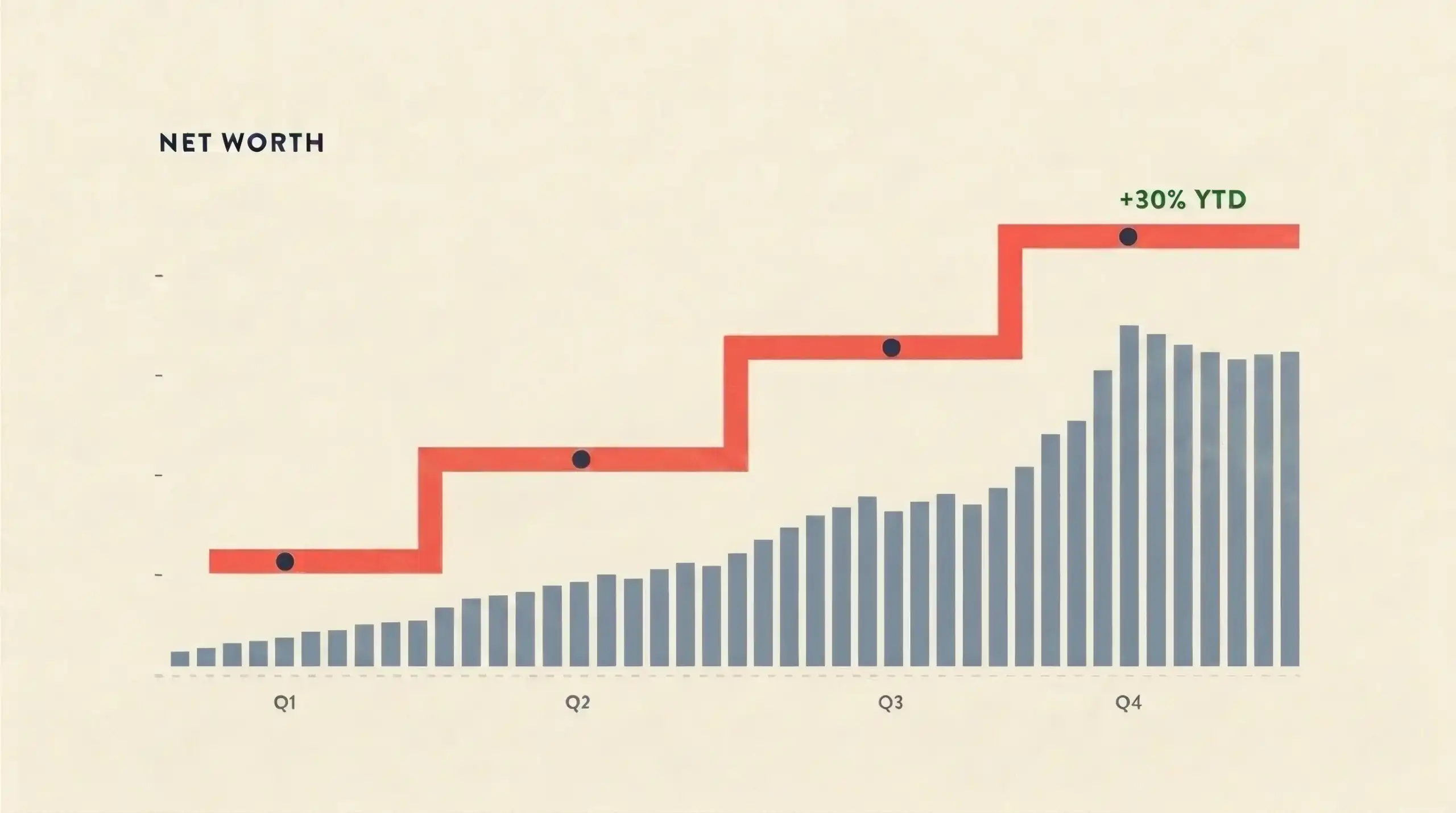

Add up your net worth, everything you own minus everything you owe, on the same day every quarter. From the change since last quarter, subtract the market’s gains on your investments and home, or add back its losses. What’s left is what your saving and debt payoff added, and it shows whether your plan works.
That split matters because, with $80,000 invested, a 6% drop erases $4,800 on paper, more than three months of saving $1,500 a month. A strong quarter does the opposite and can hide a credit card balance that keeps climbing.
Net worth is still the right scoreboard, because it’s the only number that counts every account and every debt together. But the total blends what you did with what markets did. A year of rising stocks can make a household that saved nothing look like it’s thriving, while a down year can convince a steady saver that the plan is broken. Quarterly is often enough for your saving to show up and rare enough that you won’t react to every swing.
The free Empower Personal Dashboard links your accounts and keeps a running total, and the paid budgeting app Monarch does the same. A spreadsheet with one row per account does the job if you’d rather not connect them. Set a recurring date, like the first weekend of January, April, July, and October, and run the same four steps.
- Add up cash, retirement, and brokerage accounts, and your home’s value minus the mortgage. Then subtract student loans, car loans, and card balances.
- Keep estimates steady. Update the home’s value once a year from the same source, and leave out cars and furniture but count any loan on them.
- For each investment account, take the change in its balance, subtract the quarter’s contributions, including any employer match, and add back any withdrawals. The result is the market’s share.
- Take the market’s share, and any change from updating your home’s value, out of your net worth change. What’s left is what you added.
Ride out a bad quarter without changing the plan if what you added holds steady or grows. The second quarter in a row that number shrinks, look at your spending before you touch your investments.
For an app that tracks your accounts, start with our best budgeting apps list.

Editorial & Advertiser Disclosure: The editorial content on this page is not provided, commissioned, reviewed, approved, or otherwise endorsed by any advertiser. Opinions expressed here are ours alone, not those of any advertiser. The offers that appear on this site are from companies that compensate us. That compensation may influence which products we cover and where and how they appear on a page – including the order in which they appear – but it does not influence our evaluations, ratings, or opinions. We do not include every company or offer available in the marketplace.
Related: