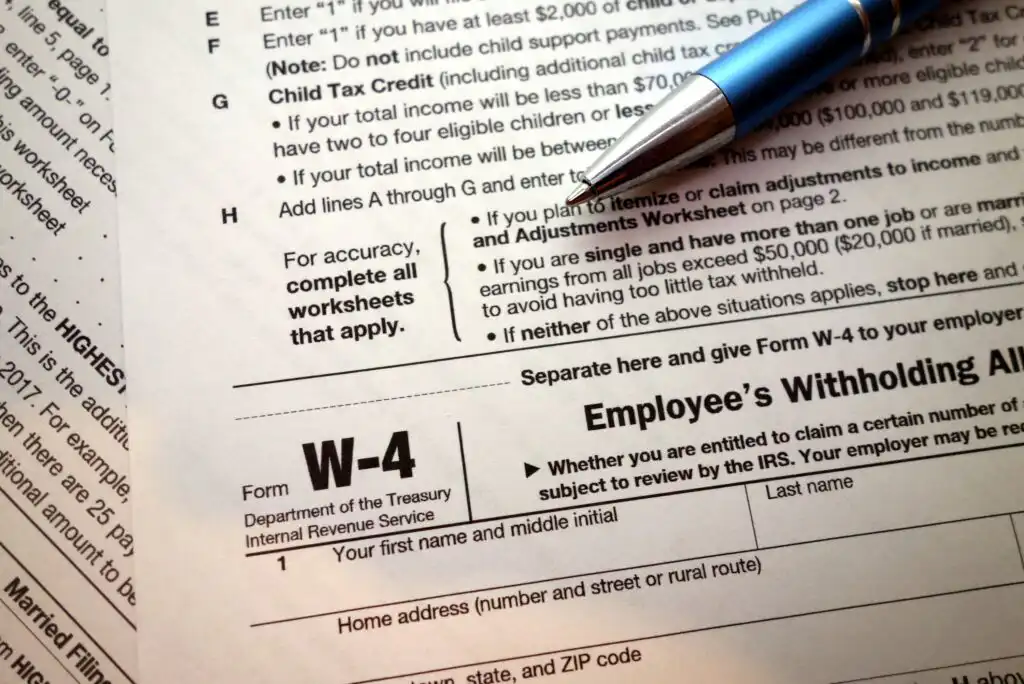

Payroll withholds tax for the household your W-4 describes until you hand in a new one. Within weeks of a wedding, a divorce, a new baby, a second job, or new side income, run the IRS Tax Withholding Estimator. Give your employer the new W-4 it fills in while enough paychecks remain to spread the correction.
Every paycheck after the change is withheld at the old setting. The gap grows each payday, and the paydays left to close it shrink.
Each employer withholds based only on its own paycheck and what your W-4 tells it, such as your filing status and children. So a spouse’s pay, a second job, or side income on your return calls for more withholding. A divorce final by December 31 usually does too, since you’ll be taxed as unmarried for the whole year while payroll still withholds as married. A new child, or a spouse with no income, lets you have less withheld.
Run the IRS Tax Withholding Estimator with your latest pay stub. It counts the new deductions for tips, overtime, seniors, and car loan interest, then fills in a new W-4 that payroll has about a month to start using. When a change like a divorce or a second job leaves you short for the year, the IRS requires the new form within 10 days.
Say newlyweds earn $60,000 each, are paid every two weeks, have no other income, and take the standard deduction. Both switch to married filing jointly in January and skip Step 2, the two-jobs step. Each employer gives its paycheck the couple’s whole standard deduction and lowest brackets, so by our math they end the year about $4,400 short. Fix it in July, and each spouse’s 13 remaining paychecks need about $170 more withheld apiece. Wait until October, and each spouse’s last six need about $360 apiece.
Side income from freelance or gig work has nothing withheld. Extra withholding in Step 4(c) can cover its tax, and when that’s more than your paychecks can spare, pay the rest in quarterly estimated payments. The IRS’s penalty rules count withholding as paid evenly through the year, so raising it in the fall also covers spring’s due dates, which a late estimated payment can’t.
Then rerun the estimator in late December, as the IRS advises, so a catch-up amount sized for a few paychecks doesn’t over-withhold all of next year.


Subscribe and we'll send you 101 Essential Money Tips to get you started.
The 101 money moves that matter most, from the foundations to protecting what you’ve built.
Advertiser Disclosure: Many or all of the offers that appear on this site are from companies that compensate us, and some companies pay for sponsored content. That compensation may influence which products we cover and where and how they appear on a page, including the order in which they appear. We do not include every company or offer available in the marketplace.