

I have been self-employed for a dozen years, and I love the flexibility and freedom of my schedule — setting my hours and being the boss. But one of the biggest challenges is applying for a mortgage.
I’ve gotten a mortgage once and refinanced twice, but I was armed with more paperwork than my spouse or any other traditional W-2 employee. I needed to be extra patient and prepared for lenders to ask about differences from year to year. I had to explain why my income changed or my expenses increased.
Mortgage brokers can become anxious about the fluctuations inherent in self-employment, but if you can explain why your business changed from year to year, it makes the process easier. Getting a mortgage is quite possible. Just be prepared with extra time, patience, and paperwork.
How to Get a Mortgage When You’re Self-Employed
Applying for a mortgage is never easy because you need solid credit and a down payment. The rules for self-employed individuals are the same as for everyone else. But documenting your income, cash flow, and client payments takes more paperwork than if you’re a W-2 employee who gets the same paycheck each week.
Whether you’re looking to buy a home now or planning for the future, an affordable mortgage is within your reach, even if you’re self-employed. You just need to know how to make your application more appealing to lenders and what options you have.
Making Your Application More Appealing to Mortgage Lenders
When you apply for a mortgage, your application must be rock-solid. That makes it difficult for lenders to turn you down. They want to ensure you’ll never miss a mortgage payment. To prove your creditworthiness means making sure your credit is top-notch and you can verify all your income.
Demonstrate an Employment History of 2+ Years
Lenders want at least two years of employment history, including demonstrable proof you’re self-employed.
You can prove your self-employment status by submitting tax documents and returns showing you’re a 1099 worker. They may also ask for a business license or the paperwork you used to set up a limited liability company (LLC). Your accountant can also provide a letter explaining your self-employed income and can answer any questions.
Provide Income Documentation
In addition to tax returns, your lender might want to see the actual payments made from clients. You must document these payments and show proof of receipt.
For instance, if one client sends an old-school check each quarter, you must show evidence of that quarterly check. If other clients pay you per project, you must also show that documentation.
Online payments are now widespread, and you should be able to download those documents from your bank to illustrate consistent income. Some clients even pay via systems like Venmo, and those online documents are also available.
Improve Your Credit Score
One of the biggest reasons for mortgage denial is having a low credit score, and you must run your credit report to determine whether you need to raise it.
You’d like to have a score of 620 or higher. It’s technically possible to get approved if your credit score is lower. For example, Fannie Mae only requires a 580. But don’t count on that being an option. And the higher your credit score, the more favorable terms you’ll get.
You must check your credit score with all three agencies: Equifax, Experian, and TransUnion. Mortgage lenders typically pull all three and use the median score, so you need to know what they’ll see on each one.
If there are errors, contact the credit-reporting agency and dispute them. If your report is accurate but the score still isn’t high enough, you need to improve your credit by doing things like paying bills on time and reducing debt.
For your Experian score, you can sign up for Experian Boost for free. It factors on-time payment of regular bills like electricity and streaming services into your score. It only raises your Experian score, but since they use the median of all three scores, it could still help.
One thing all credit rating systems scrutinize is the credit utilization ratio. For instance, if you have a card with a credit limit of $6,000 and you owe $3,000 on the card, your credit utilization is 50%.
Many credit bureaus suggest you keep this rate no higher than 30%. So on a card with a $6,000 limit, you want to have no more outstanding credit than $1,800. If yours is higher, pay it down.
Improving your credit score doesn’t happen overnight, but it’s essential to increase it as much as possible. For more information, see our article on improving your credit score.
Lower Your Debt-to-Income Ratio
Your debt-to-income ratio is how much you owe each month compared to how much you earn. That’s an essential factor lenders use to determine whether you’re a good candidate for a loan.
To calculate your debt-to-income ratio, add up all your monthly debt obligations. Those include things like:
- Car loans
- Student loans
- Alimony or child support
- Personal loans
- Payments on medical debt
It does not include your regular expenses, such as utilities and food. Divide that number by your monthly gross income (before taxes). Then move the decimal over twice to the right to get the percentage.
For example, let’s say you have student loans and a car payment totaling $1,000 per month, and your gross monthly income is $4,000.
$1,000 ÷ $4,000 = 0.25
After moving the decimal over twice to the right, we get a debt-to-income ratio of 25%.
Most lenders want a debt-to-income ratio of about 36% or lower and don’t want it any higher than 43%. If you have a monthly income of $6,000 and monthly debt of $3,000, then your debt-to-income ratio is 50%, which would be considered too high by many lenders. The task is to reduce your debt or increase your income.
Build Your Emergency Savings
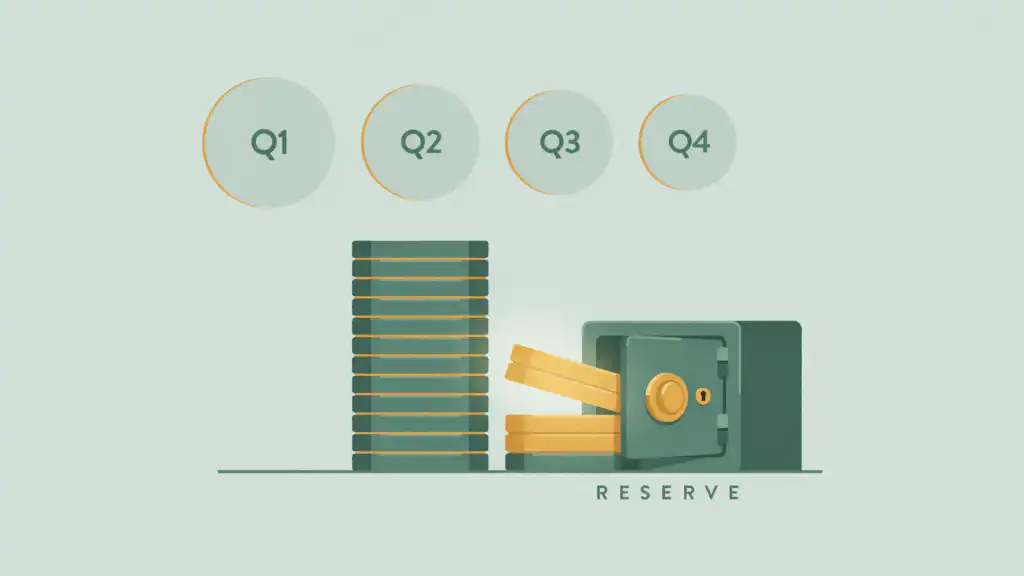
Being a business owner means your income can fluctuate, so lenders like to see that you have emergency savings ready to go. The mortgage is due each month, and if you lose a client or revenue stream, lenders are eager to know you still have a way to pay the mortgage.
The amount you should save varies. But generally, you should have at least three months of expenses — and six months of payments would be even better. The goal is to start with at least $1,000 in savings and then build.
Offer a Large Down Payment
Historically, people would save for years for a 20% down payment, making buying a house a long and arduous process. Then, the rules became lax during the 2007-2008 recession, when buyers had no down payment. After that crisis, lenders sought at least a 3% down payment.
But for self-employed individuals, getting a home loan is easier if you’ve got a higher down payment. Indeed, a down payment of even 7% to 10% is attractive. And if you’ve got a down payment of 20%, you can avoid costly private mortgage insurance.
Keep Your Personal & Business Expenses Separate
Each time I’ve gotten a mortgage or refinance, the lender has wanted the personal and business expenses to be separate.
And depending on the nature of your business, it can be a challenge to separate them. But it’s not as hard as you imagine. If you’re still preparing to take out a mortgage, it’s not too late. It comes down to setting up one business account and at least one personal account.
All your payments from clients would funnel into the business account. You pay your business expenses, such as Grammarly or QuickBooks, from that account. Then, you write yourself a monthly paycheck from the business account and put that money in your personal account, which you use to pay your monthly household bills.
But not all business expenses are so straightforward. For instance, maybe you work from home and use some utilities or equipment for both business and pleasure.
In that case, you must track how much you use them for work. You can then deduct that percentage of your bill, such as your internet charges, as a business deduction. Note that for some expenses, such as utilities, it may also depend on the size of your home office. Talk to an accountant for more information.
Ultimately, keeping your expenses separate makes it easier to provide your lender with a business profit and loss statement showing how much money the company has earned in a year and any debts.
If it’s too late and you’ve kept your personal and business expenses together, you must also explain why you chose to do so. Lenders will allow it if you can reasonably explain how your business and personal expenses overlap, primarily if you work from home and use utilities like internet and trash services for personal and business use.
Limit Your Tax Deductions
Tax deductions are exciting for those of us who are self-employed. But the problem is it reduces your income dramatically. Suppose you’ve got a monthly income of $6,000, which is $72,000 per year. That gives you good buying power for a house, depending on your debts.
But if that $6,000 per month includes $3,000 of tax deductions, then the lenders only count your income as $3,000 per month, or $36,000 per year.
While it’s appealing to write off as much as possible for tax purposes, lenders are interested in a consistent yearly income. If you had $5,000 in expenses one year and $15,000 the following year, it can look like a dramatic drop in revenue.
Instead, you can split the business expenses over multiple years to show a consistent income. For example, say you’re a podcaster who needs to upgrade your equipment. You can buy a new studio board this year, then upgrade mics, headphones, and editing software next year or over the next couple of years.
Or you can just depreciate the equipment on your tax returns. That allows you to buy everything you need upfront and take a portion of the deduction for each year you expect the equipment to be in service.
But before opting for that route, speak with your accountant to ensure the type of equipment you need meets the IRS requirements. They can also help you determine which tax deduction strategies best suit your needs.
Home Loan Options for Self-Employed Borrowers
When purchasing a house, multiple loans are available to you, and each has its pros and cons.
Joint Mortgage
A joint mortgage is simply a mortgage shared by multiple parties. It’s common for joint mortgage applicants to be spouses or partners.
The self-employed person must still have solid credit, even if their spouse or partner receives a W-2 and has an excellent credit history. If both have stellar credit, then the interest rates go down. In a joint mortgage, lenders use the lowest credit score of the two.
But don’t be tempted to keep your name off the mortgage just because you’re self-employed or your credit score is lower. It’s best to have both spouses’ or partners’ names on the mortgage in the event of a separation, divorce, or death.
But the other signatory on your joint mortgage isn’t required to be a spouse or partner. Your co-borrower could be a friend or family member. If you have a friend or relative you don’t mind living with looking to purchase a home, you can pool financial resources to buy a home sooner, qualify for a bigger loan, or offer a larger down payment.
But think carefully about whether it’s a good idea to buy a house with a friend or relative. At the very least, you need to set up some guidelines, such as an exit strategy if one of you finds a romantic partner or wants to move.
Whether it’s with a partner or friend, when you buy a house with a joint mortgage, you agree to share responsibility for the loan. But if your income fluctuates dramatically, having an applicant with a steadier income stream bolsters your application.
Get a Co-Signer
If lenders are frowning at your application because of your credit report or fluctuating income, getting a co-signer can help. Unlike a co-borrower on a joint loan, a co-signer is someone who agrees to take on the financial responsibility of the loan if you can no longer make payments. Often, a family member such as a parent signs on as a co-signer.
The co-borrower appears on the property’s title, and the co-signer doesn’t. Ideally, your co-signer has a much better credit score and history than you do. That reduces the risk to lenders and leads to more attractive loans.
But co-signing is a legally binding contract. The lender can come after the co-signer for payments if you default on the mortgage.
Government-Backed Loans (FHA, VA, HUD, & USDA)
A traditional mortgage is an agreement between you and the bank that the bank will essentially buy you a house, and you’ll pay them back plus interest. The bank sets high standards to ensure they get their money back and get paid for the service.
But that leaves some borrowers unable to get a mortgage. Enter the federal government. Several government agencies have programs designed to help buyers, especially first-time home buyers, achieve their dream of homeownership.
You still get the loan at a traditional bank. But the government backs the loans, making them much less risky for lenders. The government does require you to meet rigid standards, but the income and credit score requirements are less stringent.
If you qualify for one of these government-backed loans, it could be well worth your time to apply:
- Federal Housing Administration: Down payment of 3.5% with a 580 or higher FICO score or 10% if your FICO score is lower; mortgage insurance premium required; debt-to-income ratio must be less than 43%; must be your primary residence; interest rates can be higher than a conventional mortgage
- Department of Agriculture: Must live in a rural area; no down payment required; applicants must meet income requirements and can’t exceed 115% of U.S. median household income; must be a U.S. citizen and occupy the dwelling as a primary residence
- Department of Housing and Urban Development: Attractive for buyers with poor credit and little to no down payment; interest rates might be higher; upfront mortgage insurance premium required in most cases
- Department of Veterans Affairs: Limited to military personnel and veterans; no down payment required; no income requirements; 100% financing; low interest rates; low closing costs; no private mortgage insurance
Bank Statement Loan
A bank statement loan allows you to verify your income on a mortgage application using documented bank deposits instead of tax forms.
This type of mortgage is attractive to self-employed individuals because they may not have conventional tax documents to verify income. And even if you have tax documents, your annual income may look lower than it really is because of tax deductions and write-offs.
But you can’t simply state your income. You must show regular monthly deposits to qualify for the loan. So this loan is best for those who have multiple clients on monthly retainer, have customers who reliably order monthly, or can show steady income each month (regardless of the source).
But you should also apply for other loan types if you qualify. Bank statement loans are riskier for lenders and can come with a higher interest rate and larger down payments.
Portfolio Loan
A portfolio loan is different from any of the other loans. You typically need good credit, a prior relationship with the lender, or to be a local business owner the bank would like to court for a long-term relationship.
As such, they’re rare. But it can be an excellent program for those who’ve had a few months with fluctuating income and are finding it challenging to get a typical mortgage.
Usually, the bank lends someone money, then sells the debt to another creditor for a profit so they can make money to offer more loans. But on a portfolio loan, they agree to keep it in-house, at least for a time. That means they have 100% of the liability if you default.
The requirements may be less flexible, resulting in a higher interest rate and costlier fees.
Work With an Experienced Mortgage Broker
Find a mortgage broker who’s worked with many self-employed individuals and understands the options available.
You want someone who’s flexible, can make choices at their firm, and can take a holistic approach to your application. Too often, self-employed individuals get nixed because their applications don’t check all the boxes less experienced brokers want to check. You want someone who can help you make your application more attractive.
Self-Employed Mortgage FAQs
There are some basic guidelines self-employed individuals must follow when applying for a mortgage. Homeownership is attainable, but you want your loan application to be stellar and show a good credit history as you go through the mortgage process.
Are Mortgage Rates Higher for Self-Employed Borrowers?
The mortgage rates aren’t necessarily higher for self-employed individuals. If you have an excellent credit rating and can show years of consistent income with low debt, you should be able to secure a stellar interest rate.
But if your credit rate is rocky and your income fluctuates, you might see higher interest rates.
Is It Harder to Refinance a Mortgage if You’re Self-Employed?
It’s not necessarily harder to refinance a mortgage if you’re self-employed. But it takes more time to gather your paperwork. You must have at least two years of self-employed income, though many lenders appreciate more. If your income fluctuates, it takes more time to prove your creditworthiness.
Final Word
It might seem overwhelming to save for a down payment and get a mortgage when you’re self-employed. You may worry you have to give up your dream business for a day job to get a house.
But that’s not the case. You can have a business and a home as well. Just be patient. And if your credit rating isn’t excellent, go through the necessary steps to improve your credit.

Editorial & Advertiser Disclosure: The editorial content on this page is not provided, commissioned, reviewed, approved, or otherwise endorsed by any advertiser. Opinions expressed here are ours alone, not those of any advertiser. The offers that appear on this site are from companies that compensate us. That compensation may influence which products we cover and where and how they appear on a page – including the order in which they appear – but it does not influence our evaluations, ratings, or opinions. We do not include every company or offer available in the marketplace.
Related: