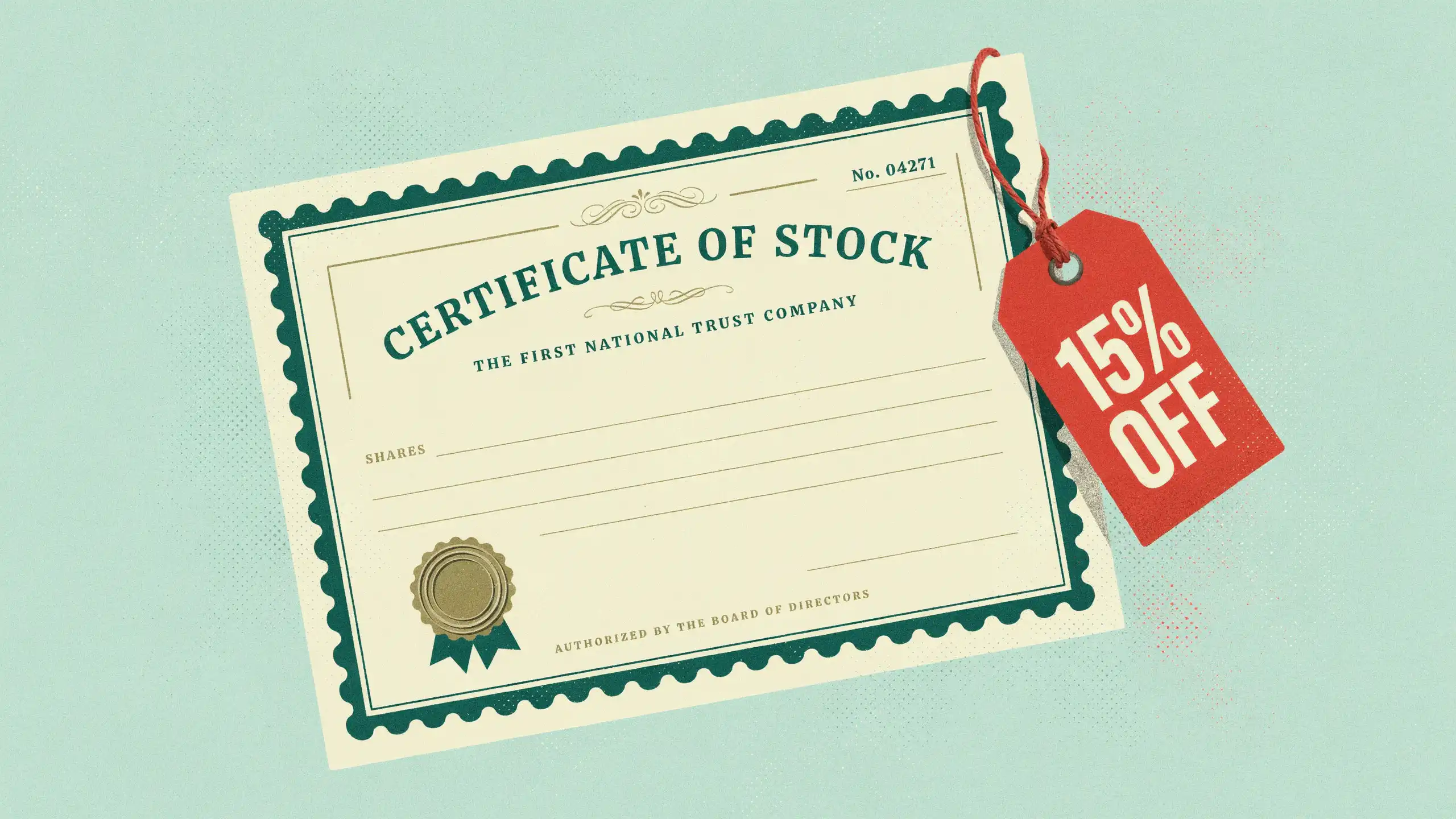

If your employer offers an employee stock purchase plan (ESPP), enroll and sell each batch of shares as soon as your plan allows. With the usual 15% discount, every $85 you put in buys $100 of stock, a 17.6% gain before taxes, and none of your savings stays tied to the company that already pays you.
That answers the best reason to skip the plan. Your paycheck already depends on your employer, and holding its stock too would double the bet.
An employee stock purchase plan collects after-tax payroll deductions over an offering period, most often six months, then buys company shares at up to 15% off. Most plans add a lookback, which applies the discount to the lower of the stock’s price when the offering starts and on the purchase date.
The discount is the return. At 15% off, $200 from each biweekly paycheck over a six-month offering, $2,600 in all, buys about $3,059 of stock. If you can sell once the shares arrive, the $459 difference is a 17.6% gain before taxes on money tied up for three months on average. The price can still move before your sale, but it would have to drop 15% to erase the gain. A holding period, required at one in ten companies with a tax-qualified plan in a 2023 NASPP and Deloitte survey, gives the price more time to fall. With a lookback, a climb from $40 to $50 during the offering means paying $34 for each $50 share.
Sell right away, and the gap between the purchase-date price and what you paid is taxed as ordinary income, like a bonus, and usually appears on your W-2. A qualifying sale, more than two years after the offering starts and a year after purchase, still taxes the discount as income. What you get is the lower long-term capital gains rate on any rise in the price, in exchange for holding one company’s stock for a year or more.
Make it work in three steps:
- Pick a contribution you can live without for the whole offering period.
- Confirm your plan has no holding period.
- Use the adjusted cost basis from your broker’s supplemental statement, which counts the taxed discount as part of what you paid. The 1099-B leaves it out, and filing from it taxes the discount twice.
If you wouldn’t spend a cash bonus on your employer’s stock, don’t keep the shares your ESPP buys either.

Editorial & Advertiser Disclosure: The editorial content on this page is not provided, commissioned, reviewed, approved, or otherwise endorsed by any advertiser. Opinions expressed here are ours alone, not those of any advertiser. The offers that appear on this site are from companies that compensate us. That compensation may influence which products we cover and where and how they appear on a page – including the order in which they appear – but it does not influence our evaluations, ratings, or opinions. We do not include every company or offer available in the marketplace.
Related: