
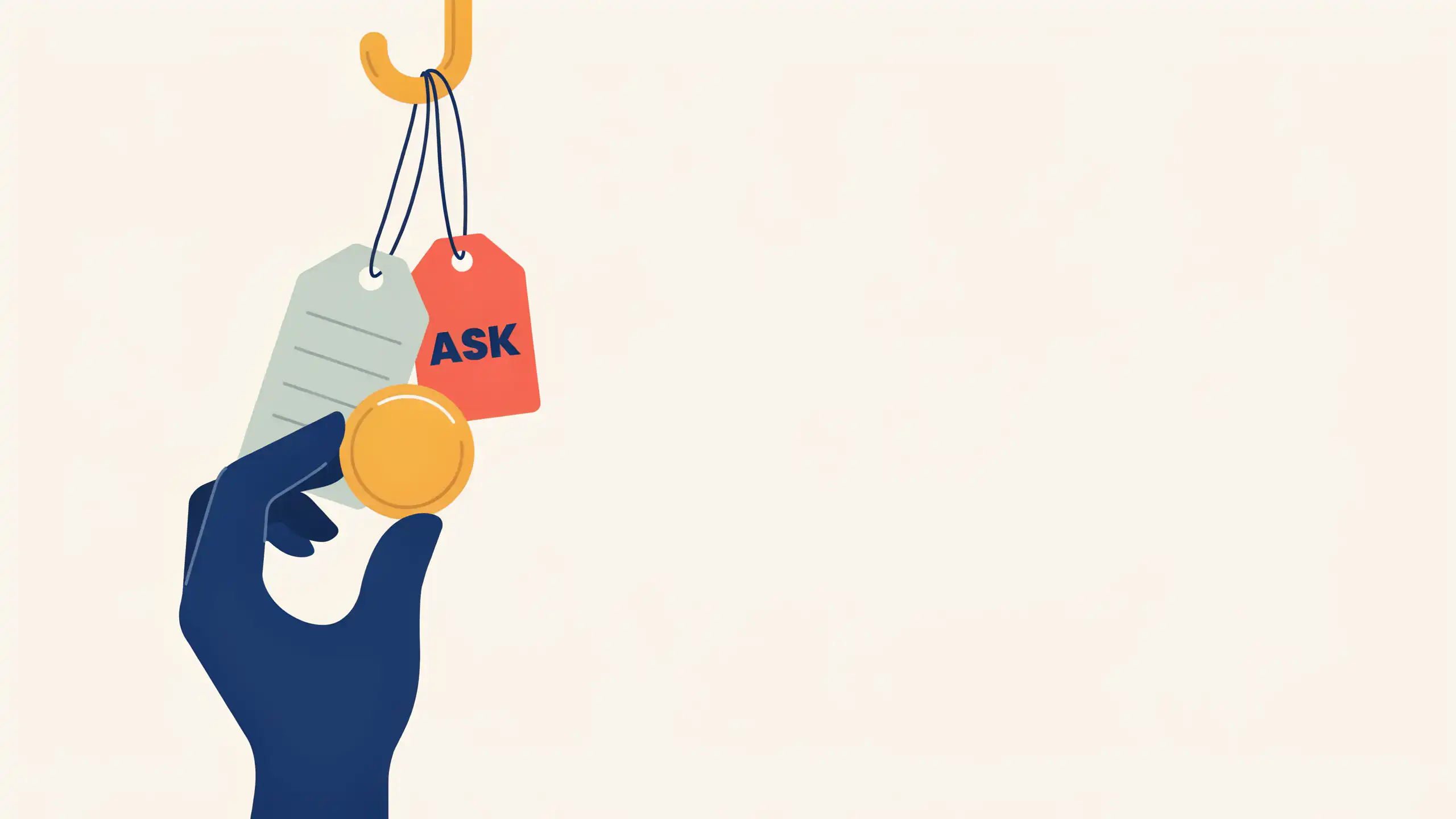

You buy at a stock quote’s ask, the lowest price a seller will take, and sell at its bid, the highest a buyer will pay. The gap between them costs you the moment you buy, and it’s usually widest on stocks that trade few shares. When it’s wide, use a limit order to set the most you’ll pay.
The big number on the quote is the last price, what the most recent trade paid. Your order won’t necessarily get it.
Say a stock last traded at $10.20 and is quoted at $10.00 bid and $10.40 ask. A market order, which buys at once at the best price available, pays about $10.40. Sell right back for about $10.00 and you’ve lost 40 cents a share, almost 4% of what you paid.
On a large company’s stock or a popular exchange-traded fund, that gap, called the spread, is often a penny during regular trading hours, a tiny fraction of the price. Low volume, meaning few shares trade each day, leaves fewer buyers and sellers competing on price, so the gap is wider.
Here’s what the rest of the quote shows:
- Change is how far the price has moved since the previous close, in dollars and percent.
- Bid size and ask size are how many shares are waiting at those prices.
- Volume counts the shares traded so far today, and average volume is a typical day’s total.
- Day’s range is today’s lowest and highest prices.
- 52-week range does the same for the past year.
- Market cap is the company’s total market value, its share price times all its shares.
- P/E ratio is the share price divided by a year of earnings per share.
- Dividend yield is a year of dividends as a percentage of the share price.
Use a limit order on any stock with a wide gap, since a market order bigger than the ask size can buy the rest at higher prices. At the open and after hours, use one on every stock. An overnight market order usually goes through at the opening price, which can be far from the last price you saw. After hours, the Securities and Exchange Commission says the gap usually widens and many brokers accept only limit orders.
Set your limit no higher than the ask on the quote, so you never pay more than that price.
Find a broker for your first trade among the best online stock brokers for beginners.

Editorial & Advertiser Disclosure: The editorial content on this page is not provided, commissioned, reviewed, approved, or otherwise endorsed by any advertiser. Opinions expressed here are ours alone, not those of any advertiser. The offers that appear on this site are from companies that compensate us. That compensation may influence which products we cover and where and how they appear on a page – including the order in which they appear – but it does not influence our evaluations, ratings, or opinions. We do not include every company or offer available in the marketplace.
Related: