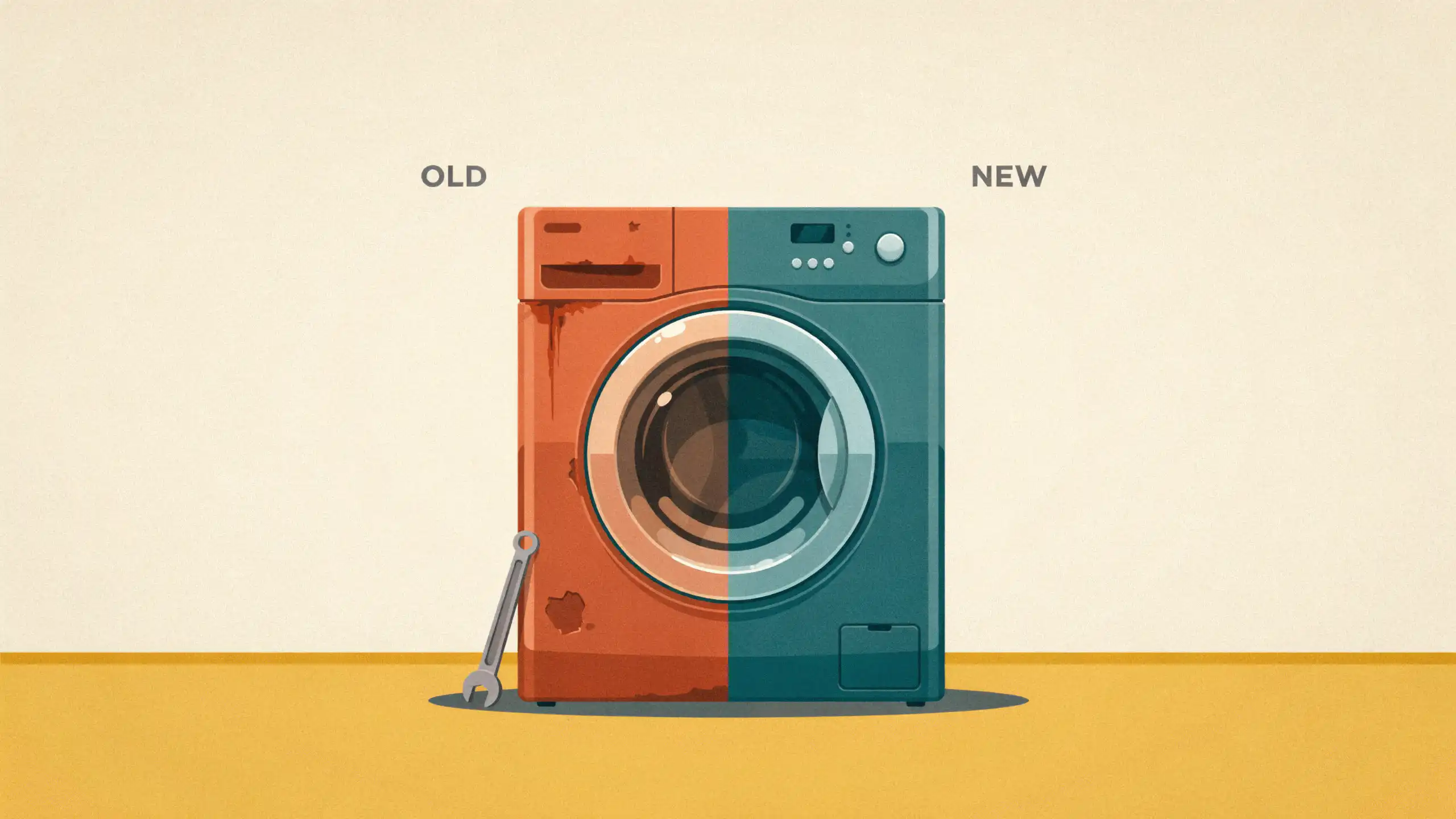

When a major appliance breaks, run the 50% rule before you shop for a replacement. Replace it if it’s past the halfway point of its expected lifespan and the repair would cost more than half the installed price of a comparable new model. Otherwise, pay for the fix, unless the part it needs is no longer made.
A repair quote on an aging machine tempts you to pay whatever it takes to avoid shopping, or to buy new because the bill feels big. The 50% rule replaces both instincts with arithmetic.
The rule needs two numbers. The first is the appliance’s age against its typical lifespan. InterNACHI, an association of home inspectors, puts that at about 9 years for a dishwasher and 13 for a dryer. It puts a refrigerator at 9 to 13 years, a tank water heater at 6 to 12, and a washer at 5 to 15. For those three, use the middle of the range. The second is the repair quote against the installed price of a comparable new model.
Take an eight-year-old dryer with a $350 repair quote and an $800 installed replacement. It’s past the midpoint of its 13-year lifespan, but $350 is about 44% of $800. Age says replace, but cost says repair. The rule calls for replacing only when both agree, so you fix it.
Before you do the math, take these steps in order.
- Check every warranty first: the manufacturer’s, any extended plan you bought, and your credit card’s. Many cards extend the manufacturer’s warranty, often by a year, when you paid with the card.
- Get a diagnosis and a written quote that names the failed part, the parts cost, and the labor.
- Price a comparable new model with delivery, hookup, and haul-away included, not just the sticker price.
A rebate lowers what a new model costs you, so subtract any you qualify for from the installed price. Energy Star’s Rebate Finder lists local rebates by zip code. An Energy Star certified washer uses about 20% less energy and 30% less water than a standard new one. If the part your machine needs is no longer made, replace it regardless of the math.
Do the legwork before anything breaks. Photograph each appliance’s model label and receipt and keep them in one album, so its age, its warranty, and the card you paid with are on hand when the next quote arrives.

Editorial & Advertiser Disclosure: The editorial content on this page is not provided, commissioned, reviewed, approved, or otherwise endorsed by any advertiser. Opinions expressed here are ours alone, not those of any advertiser. The offers that appear on this site are from companies that compensate us. That compensation may influence which products we cover and where and how they appear on a page – including the order in which they appear – but it does not influence our evaluations, ratings, or opinions. We do not include every company or offer available in the marketplace.
Related: