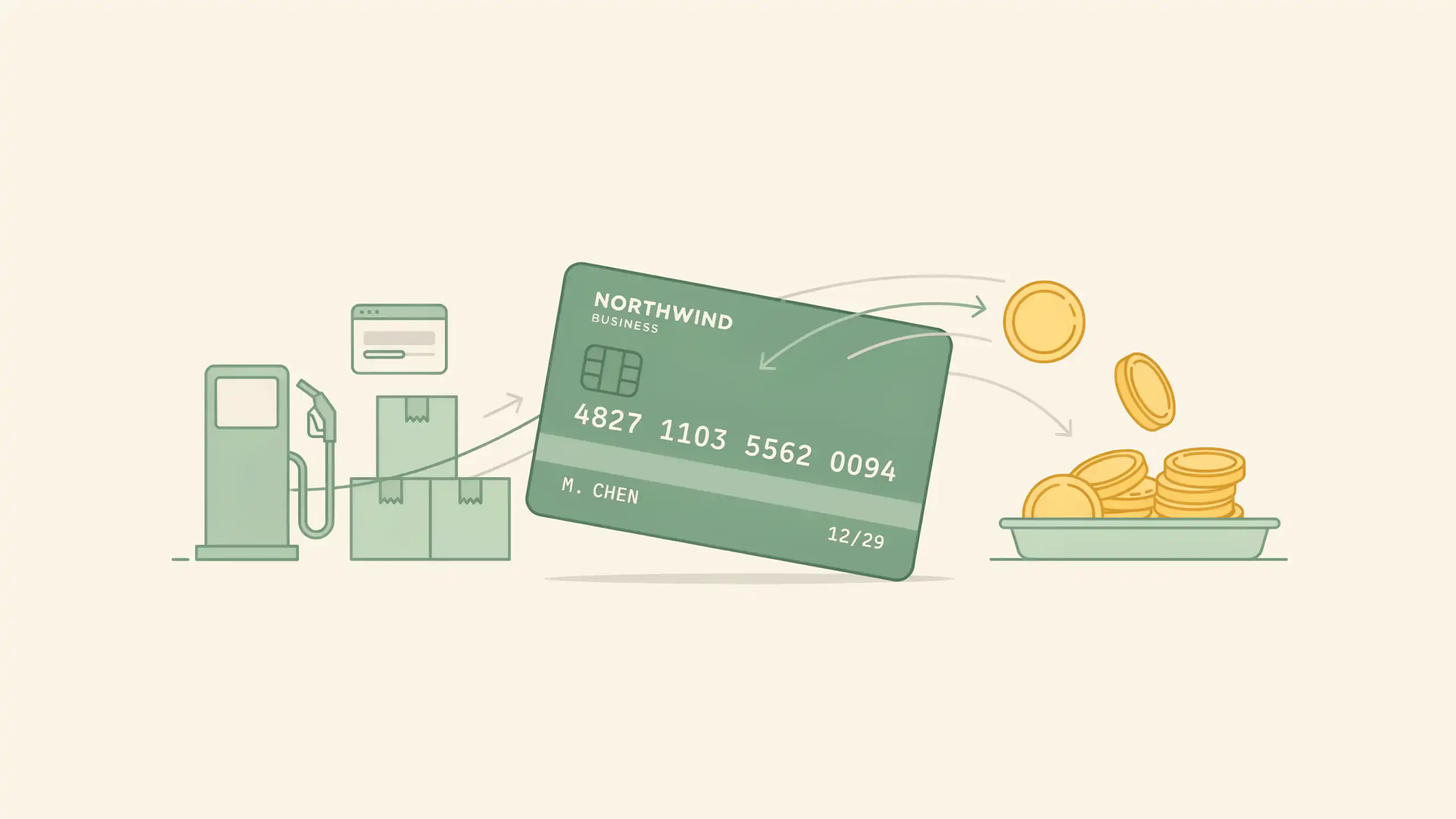

If you earn self-employment income, run your business expenses through a business credit card and keep personal spending off it. The statement becomes a running record of your business costs at tax time, and you earn rewards on spending you’d do anyway. Pay the balance in full each month.
Mixing business and personal charges on one card leaves you sorting every line at tax time, and each business cost you miss is a deduction you don’t take.
The IRS tells new business owners to open a business checking account and keep it separate from their personal one. A card you use only for business extends that separation to spending. Its statement lists the amount, the payee, and the date of every charge, which the IRS counts as acceptable proof of payment. Keep receipts or invoices too, because the IRS says proof of payment alone doesn’t establish a deduction.
The rewards take no extra work. Chase’s Ink Business Cash card, for one, pays 5% cash back on internet, cable, and phone bills and at office supply stores, on up to $25,000 of combined spending each account year. The card has no annual fee, so a freelancer who puts a $150 monthly phone and internet bill on it nets $90 a year for doing nothing different.
You typically don’t need an LLC or an employer identification number to apply. Most issuers let you use your legal name and Social Security number, according to Capital One, and the issuer may weigh your personal credit and income. It may also require a personal guarantee, which makes you responsible for the balance if the business can’t pay.
Make the card your default for business spending. Move subscriptions, software, and supply orders onto it, and pay the balance in full every month. Carrying a balance is riskier on a business card than on a personal one. These cards fall outside the Credit CARD Act, the 2009 law that limits how issuers can raise rates on personal cards, though some issuers extend parts of it voluntarily.
Before each purchase, ask whether it belongs on your Schedule C, the tax form where you report business expenses. If it doesn’t, it goes on a different card.

Editorial & Advertiser Disclosure: The editorial content on this page is not provided, commissioned, reviewed, approved, or otherwise endorsed by any advertiser. Opinions expressed here are ours alone, not those of any advertiser. The offers that appear on this site are from companies that compensate us. That compensation may influence which products we cover and where and how they appear on a page – including the order in which they appear – but it does not influence our evaluations, ratings, or opinions. We do not include every company or offer available in the marketplace.
Related: