
CD rates have ranged from double digits in the early 1980s to near zero in 2021, because they follow the rate the Federal Reserve targets. Since nobody can predict the next turn, judge today’s rates against that history, then lock in part of your savings with a CD ladder and shop beyond your own bank for each CD.
The FDIC’s national average rate on a five-year CD is 1.41%. Synchrony Bank pays 4.80% on its five-year CD.
That gap is the part of a CD’s rate you control. The general level of CD rates follows the federal funds rate, the rate banks charge one another to borrow overnight, which the Federal Reserve steers by setting a target range for it.
The table below shows how closely. From 1967 through 2008, the three-month CD’s yearly average never strayed more than 1.04 percentage points from the federal funds rate’s. The FDIC’s average, which takes over the CD column in 2009, has trailed the federal funds rate by as much as 3.95 points, in 2023, when the average three-month CD paid 1.07% and the federal funds rate averaged 5.02%.
CD rates by year since 1967
Each figure below is a yearly average, and inflation is the yearly change in consumer prices.
| Year | 3-month CD | Federal funds rate | Inflation (CPI) |
|---|---|---|---|
| 1967 | 5.02% | 4.22% | 2.8% |
| 1968 | 5.86% | 5.66% | 4.3% |
| 1969 | 7.76% | 8.20% | 5.5% |
| 1970 | 7.56% | 7.18% | 5.8% |
| 1971 | 5.01% | 4.66% | 4.3% |
| 1972 | 4.67% | 4.43% | 3.3% |
| 1973 | 8.42% | 8.73% | 6.2% |
| 1974 | 10.24% | 10.50% | 11.1% |
| 1975 | 6.44% | 5.82% | 9.1% |
| 1976 | 5.27% | 5.05% | 5.7% |
| 1977 | 5.64% | 5.54% | 6.5% |
| 1978 | 8.22% | 7.93% | 7.6% |
| 1979 | 11.23% | 11.19% | 11.3% |
| 1980 | 13.07% | 13.36% | 13.5% |
| 1981 | 15.91% | 16.38% | 10.3% |
| 1982 | 12.27% | 12.26% | 6.1% |
| 1983 | 9.07% | 9.09% | 3.2% |
| 1984 | 10.37% | 10.23% | 4.3% |
| 1985 | 8.05% | 8.10% | 3.5% |
| 1986 | 6.52% | 6.81% | 1.9% |
| 1987 | 6.86% | 6.66% | 3.7% |
| 1988 | 7.73% | 7.57% | 4.1% |
| 1989 | 9.09% | 9.22% | 4.8% |
| 1990 | 8.15% | 8.10% | 5.4% |
| 1991 | 5.84% | 5.69% | 4.2% |
| 1992 | 3.68% | 3.52% | 3.0% |
| 1993 | 3.17% | 3.02% | 3.0% |
| 1994 | 4.63% | 4.20% | 2.6% |
| 1995 | 5.92% | 5.84% | 2.8% |
| 1996 | 5.39% | 5.30% | 2.9% |
| 1997 | 5.62% | 5.46% | 2.3% |
| 1998 | 5.47% | 5.35% | 1.6% |
| 1999 | 5.33% | 4.97% | 2.2% |
| 2000 | 6.46% | 6.24% | 3.4% |
| 2001 | 3.69% | 3.89% | 2.8% |
| 2002 | 1.73% | 1.67% | 1.6% |
| 2003 | 1.15% | 1.13% | 2.3% |
| 2004 | 1.56% | 1.35% | 2.7% |
| 2005 | 3.51% | 3.21% | 3.4% |
| 2006 | 5.15% | 4.96% | 3.2% |
| 2007 | 5.27% | 5.02% | 2.9% |
| 2008 | 2.97% | 1.93% | 3.8% |
| 2009 | 0.53% | 0.16% | -0.4% |
| 2010 | 0.31% | 0.18% | 1.6% |
| 2011 | 0.18% | 0.10% | 3.2% |
| 2012 | 0.12% | 0.14% | 2.1% |
| 2013 | 0.08% | 0.11% | 1.5% |
| 2014 | 0.08% | 0.09% | 1.6% |
| 2015 | 0.08% | 0.13% | 0.1% |
| 2016 | 0.08% | 0.40% | 1.3% |
| 2017 | 0.10% | 1.00% | 2.1% |
| 2018 | 0.15% | 1.83% | 2.4% |
| 2019 | 0.21% | 2.16% | 1.8% |
| 2020 | 0.11% | 0.38% | 1.2% |
| 2021 | 0.06% | 0.08% | 4.7% |
| 2022 | 0.14% | 1.68% | 8.0% |
| 2023 | 1.07% | 5.02% | 4.1% |
| 2024 | 1.58% | 5.14% | 2.9% |
| 2025 | 1.46% | 4.21% | 2.6% |
| 2026 | 1.22% | 3.67% | 3.7% |
The CD column switches from the Fed’s figures to the FDIC’s in 2009, and the two measure different kinds of CDs, as the next section explains. The 2026 row averages January through October, and its inflation figure is the 12-month change through September, the latest the Bureau of Labor Statistics has published.
How the table was built
Through 2008, the CD column is the Federal Reserve’s average rate on three-month negotiable CDs, large CDs that investors trade with one another before they mature. The Fed’s H.15 report on interest rates described them as CDs from top-tier banks, generally for $1 million or more. The report gave the rate as an average of what dealers bid for them, and the Fed stopped publishing the series in 2013.
Those are market rates. Until federal caps on the interest banks could pay depositors were phased out over the six years after 1980, savers who kept their money at banks often earned well below them.
From 2009 on, the column is the FDIC’s national rate for a three-month CD, an average of what banks pay ordinary savers. The FDIC began publishing it on May 18, 2009, so the 2009 figure averages May through December. Through March 2021, the FDIC averaged the rates every bank branch offered on CDs under $100,000 and left out credit unions. Since then it has included credit unions, averaged the rates on $10,000 and $100,000 CDs, and counted each bank or credit union in proportion to its share of deposits.
In the months both series cover, May 2009 through June 2013, they never differed by more than 0.34 percentage point.
The federal funds rate column averages the Fed’s monthly figures for each year. Inflation is the change from one year’s average to the next in the consumer price index for all urban consumers, the Bureau of Labor Statistics’ measure of the prices urban consumers pay for a basket of goods and services.
What moved CD rates in each decade
1967 to 1979
Inflation climbed from 2.8% in 1967 to 11.3% in 1979, made worse by the 1973-74 Arab oil embargo, and the three-month CD rate climbed with it, from 5.02% to 11.23%. It didn’t keep pace. From 1974 through 1980, the CD’s yearly average trailed inflation in every year but 1978.
The 1980s
In October 1979, the Fed under Paul Volcker changed its approach to rein in inflation. The federal funds rate averaged 16.38% in 1981, and the three-month CD averaged 15.91%, the highest yearly average in the table. Its highest month was December 1980, at 18.65%. By 1983, inflation was down to 3.2%, while the CD still averaged 9.07%.
The 1990s
After the 1990-91 recession, the three-month CD averaged 3.17% in 1993, its lowest yearly average since the series began in 1964. From 1994 through 1999 it stayed between 4.63% and 5.92%, while inflation ran under 3% every year.
The 2000s
The CD averaged 6.46% in 2000 and 1.15% in 2003, as the federal funds rate fell from 6.24% to 1.13% around the 2001 recession. It climbed back to 5.27% in 2007. Then came the financial crisis, and by December 2008 the Fed had cut its target to a range of 0% to 0.25%, its record of rate changes shows.
The 2010s
From 2010 through 2019, the FDIC’s average three-month CD paid between 0.08% and 0.31% a year. The Fed began raising its rate in December 2015, and by 2019 the federal funds rate averaged 2.16%, yet the average three-month CD paid 0.21%.
The 2020s so far
The Fed cut its target back to 0% to 0.25% in March 2020. In 2021, the average three-month CD paid 0.06%, while inflation ran at 4.7%.
The Fed then raised its target 11 times from March 2022 to July 2023, to 5.25% to 5.50%. The average three-month CD rose only as far as 1.69%, on the FDIC’s February 2024 table. Six cuts followed, from September 2024 through December 2025, and took the target to 3.50% to 3.75%. In September 2026, the Fed raised it a quarter point, to 3.75% to 4%, and on the FDIC’s October 2026 table the average three-month CD stood at 1.14%.
What the history means for your savings now
Read today’s rates against the whole table, not just the last few years. The Fed’s target after its October 2026 meeting, 3.75% to 4%, is lower than the federal funds rate’s yearly average in 34 of the 41 years from 1967 through 2007 and higher than in every year from 2009 through 2022. That puts rates in the middle of the history, well below the 16.38% average of 1981 and well above the 2010s, when the yearly average never topped 2.16%.
The history can’t tell you the next turn. The Fed’s most recent cut came in December 2025, and its next change, nine months later, was an increase.
Locking in paid off before rates fell. A longer CD bought in 2000 kept its rate while the three-month average dropped from 6.46% to 1.15% by 2003. Locking in hurt before rates rose. A saver who locked in a longer CD in 2004 kept a rate set that year while the three-month average climbed from 1.56% to 5.15% by 2006.
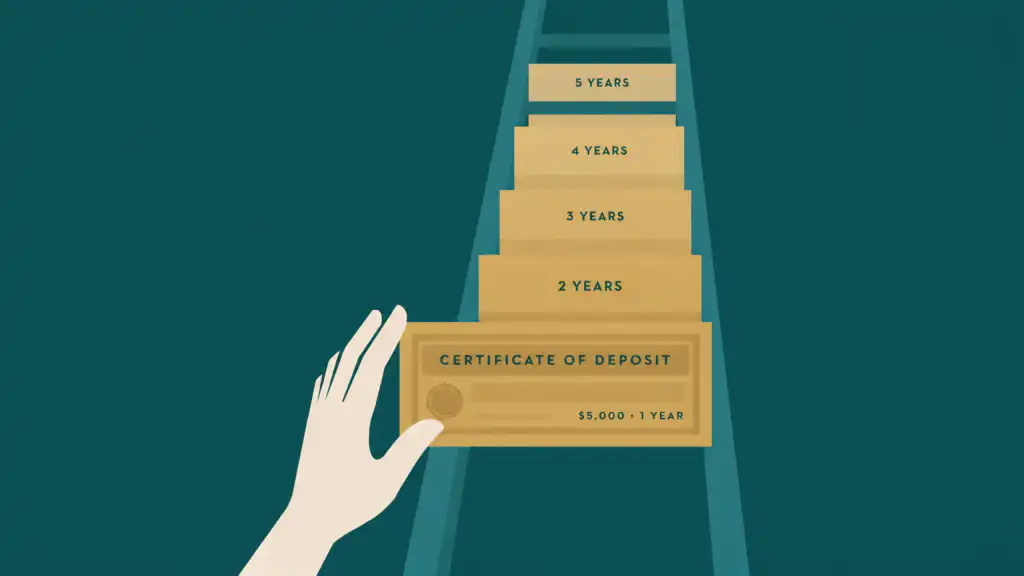
A CD ladder means you never have to pick the moment. It splits your CD money into several CDs that come due at different times, so part of it always holds a rate locked in earlier and part renews soon at whatever banks pay then.
When a CD comes due, move it to the best rate you can find for its term instead of letting it roll over at your bank’s current rate.
Compare the best CD rates for your next CD.


Subscribe and we'll send you 101 Essential Money Tips to get you started.
The 101 money moves that matter most, from the foundations to protecting what you’ve built.
Advertiser Disclosure: Many or all of the offers that appear on this site are from companies that compensate us, and some companies pay for sponsored content. That compensation may influence which products we cover and where and how they appear on a page, including the order in which they appear. We do not include every company or offer available in the marketplace.