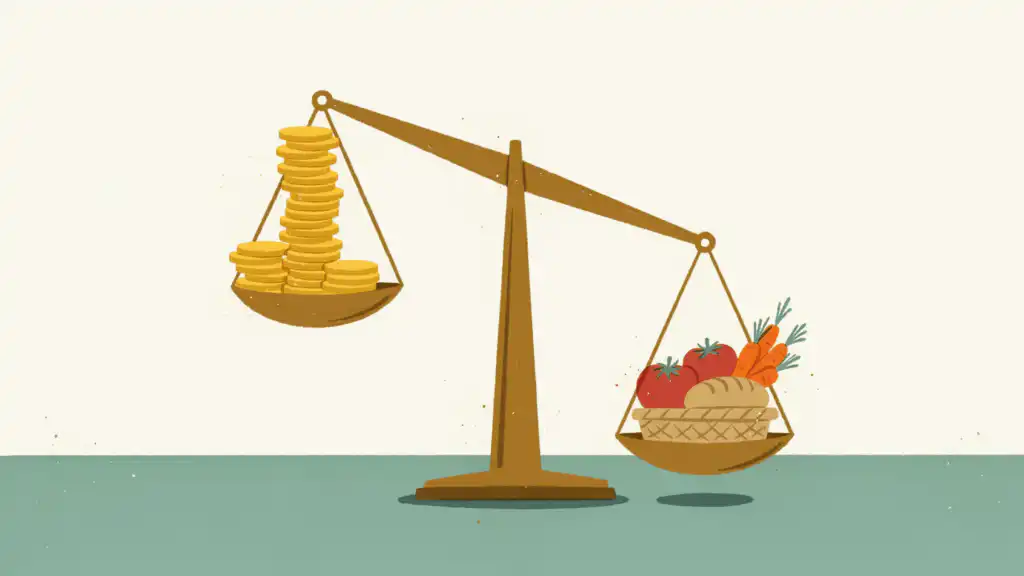

Inflation, the steady rise in prices, shrinks what each dollar you hold in cash can buy, even at the modest pace the Federal Reserve aims for. Keep your emergency fund and money you’ll spend within five years in savings, and invest the rest, since stocks have grown faster than prices over long periods.
The Federal Reserve aims for inflation of 2% a year over the long run, and even that pace doubles prices in about 35 years, so a dollar kept in cash buys half as much. In the 12 months through June 2022, prices rose 9.1%, the biggest jump in 40 years, the Bureau of Labor Statistics (BLS) reported.
Prices climb when spending outruns what businesses can supply, or when costs like energy and wages rise and get passed on to shoppers. Expectations push them up too, since people who expect higher prices ask for bigger raises and buy sooner. Savers holding cash and retirees on a pension that never rises lose ground. Borrowers with fixed-rate loans gain, since they repay in dollars that buy less, and workers whose raises keep pace hold their own.
Prices rose about 92% from January 2000 to December 2025, by the government’s Consumer Price Index. By the end, $10,000 left in a checking account that paid no interest bought only what about $5,200 bought in 2000, as the BLS’s CPI Inflation Calculator shows. Interest shrinks that loss, but only a rate above inflation, a positive real interest rate, adds buying power. So sort your money by when you’ll spend it.
Keep your emergency fund and money you’ll need within five years in a high-yield savings account, where it earns interest and can’t drop with stock prices. Invest the rest in low-cost index funds, which own hundreds or thousands of stocks at once, through your 401(k), an individual retirement account (IRA), or a brokerage account.
With dividends reinvested and before fees and taxes, $10,000 invested in the S&P 500, an index of 500 large U.S. companies, grew to about $73,900 over those years, by our math from NYU professor Aswath Damodaran’s return data. That $73,900 bought what about $38,500 bought in 2000, despite a 37% loss in 2008, which is why only money you can leave alone for years belongs in stocks.
Total your emergency fund and the next five years of planned spending, keep that much in savings, and invest every dollar beyond it.
To choose where that money goes, compare the best online brokers.


Subscribe and we'll send you 101 Essential Money Tips to get you started.
The 101 money moves that matter most, from the foundations to protecting what you’ve built.
Advertiser Disclosure: Many or all of the offers that appear on this site are from companies that compensate us, and some companies pay for sponsored content. That compensation may influence which products we cover and where and how they appear on a page, including the order in which they appear. We do not include every company or offer available in the marketplace.