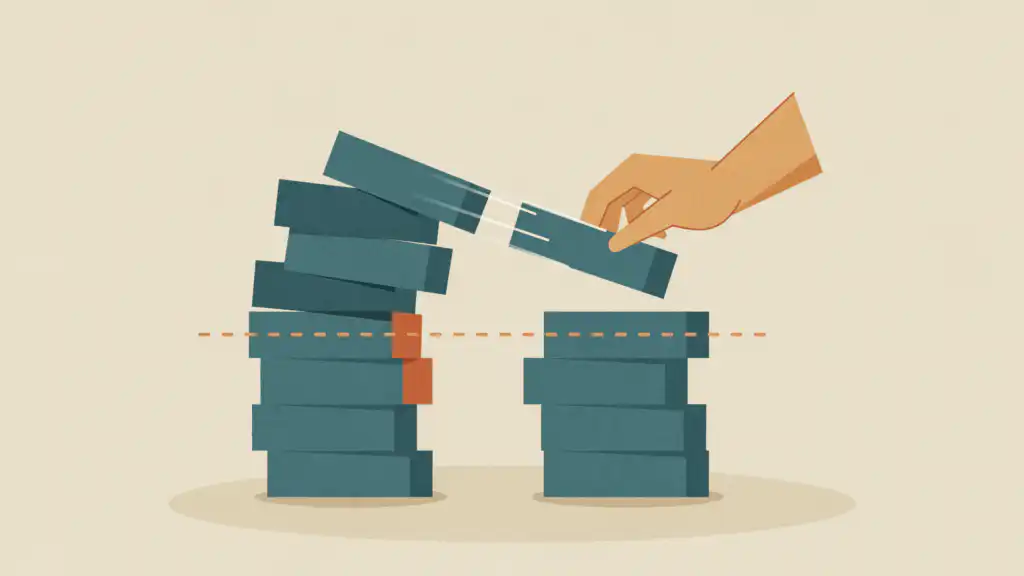



Sequence of returns risk means the order of your investment returns matters once you start withdrawing. Losses in your first years of retirement force you to sell shares at low prices, and those shares never recover for you. Keep a few years of withdrawals in cash and short-term bonds so you can wait out a downturn without selling stocks.
Two retirees can earn the same average return and end up hundreds of thousands of dollars apart.
In a Schwab example, each starts with $1 million and withdraws $50,000 a year, raised 2% annually. One loses 15% in each of the first two years and earns 6% a year after that. The other takes the same two losses in years 10 and 11. The first is nearly out of money after 18 years, while the second still has close to $400,000.
Withdrawals are what make the order matter. With no money coming out, a 15% loss and a 6% gain leave the same ending balance in either order. Once you sell shares every year to cover spending, an early loss means selling more of them to raise the same dollars, and those shares are gone before prices recover. The same loss late in retirement does less damage than an early one, because the portfolio has fewer years left to fund.
The risk peaks in the years just before and after you retire, when the balance is at its largest and withdrawals are about to start. Two defenses do most of the work. First, build a buffer. Schwab suggests holding a year of the spending your portfolio must cover in cash, plus two to four more years in high-quality short-term bonds. Second, stay flexible after a bad year by skipping the inflation raise, trimming withdrawals, or putting off a big purchase.
Before your retirement date, map where the first five years of withdrawals will come from. If the answer is selling stocks whatever the market does, move that money into cash and short-term bonds before you stop working.

Editorial & Advertiser Disclosure: The editorial content on this page is not provided, commissioned, reviewed, approved, or otherwise endorsed by any advertiser. Opinions expressed here are ours alone, not those of any advertiser. The offers that appear on this site are from companies that compensate us. That compensation may influence which products we cover and where and how they appear on a page – including the order in which they appear – but it does not influence our evaluations, ratings, or opinions. We do not include every company or offer available in the marketplace.
Related: