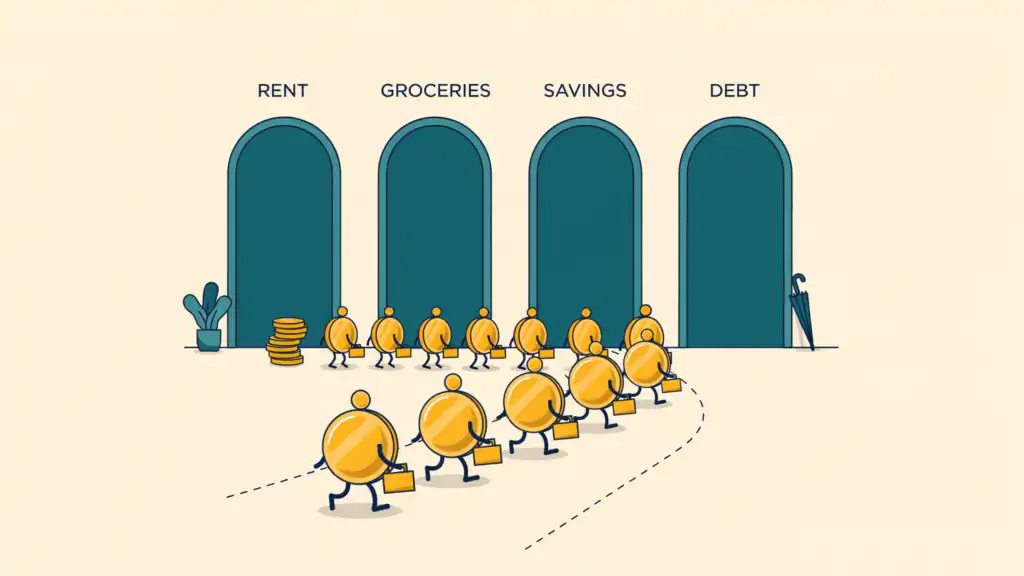

Sort last month’s spending into needs and wants, count whatever’s left as savings, and divide each total by your after-tax income. The 50/30/20 rule puts the benchmarks at 50%, 30%, and 20%. If needs or wants run over, that bucket is where your missing savings went, so fix it before you cut anything else.
Elizabeth Warren and Amelia Warren Tyagi popularized 50/30/20 in their book All Your Worth as a plan to live on, and followed that way, it breaks the first month rent alone takes 40% of your pay. Run once on last month’s numbers instead, it becomes a one-hour test of whether your money problem is spending, fixed costs, or income.
Because needs, wants, and savings add up to 100% of your income, savings can’t fall below 20% unless needs or wants run over. Whichever one runs over is the cause.
Needs well above 50% point to housing, a car, or insurance costing more than your income can carry. Wants above 30% point to spending habits. And if needs run high even though your rent and car are modest for where you live, the paycheck is the problem, and the fix is earning more, not cutting more.
To run the checkup, add up last month’s take-home pay plus anything withheld from your paycheck for a 401(k) or health insurance, and count the premiums as a need. Then sort every bank and card transaction from the month. Needs are housing, utilities, groceries, insurance, transportation, child care, and minimum debt payments. Wants are takeout, streaming, travel, and other spending you could skip. Everything else, including the 401(k) money, transfers to savings, and debt payments above the minimum, counts as savings. Divide each total by your income.
Say your monthly income is $4,000 and needs take 62% of it, or $2,480. Rent and a car payment make up $1,800 of that. Wants take 28%, which leaves 10% for savings. Dropping a $160 takeout habit lifts savings to just 14%. The missing six points are tied up in needs, which run 12 points over, and closing them means lowering fixed costs like rent and that car payment.
Fix the bucket that’s over, not the one that’s easiest to cut, and rerun the checkup after any raise, move, or new loan payment.

Editorial & Advertiser Disclosure: The editorial content on this page is not provided, commissioned, reviewed, approved, or otherwise endorsed by any advertiser. Opinions expressed here are ours alone, not those of any advertiser. The offers that appear on this site are from companies that compensate us. That compensation may influence which products we cover and where and how they appear on a page – including the order in which they appear – but it does not influence our evaluations, ratings, or opinions. We do not include every company or offer available in the marketplace.
Related: