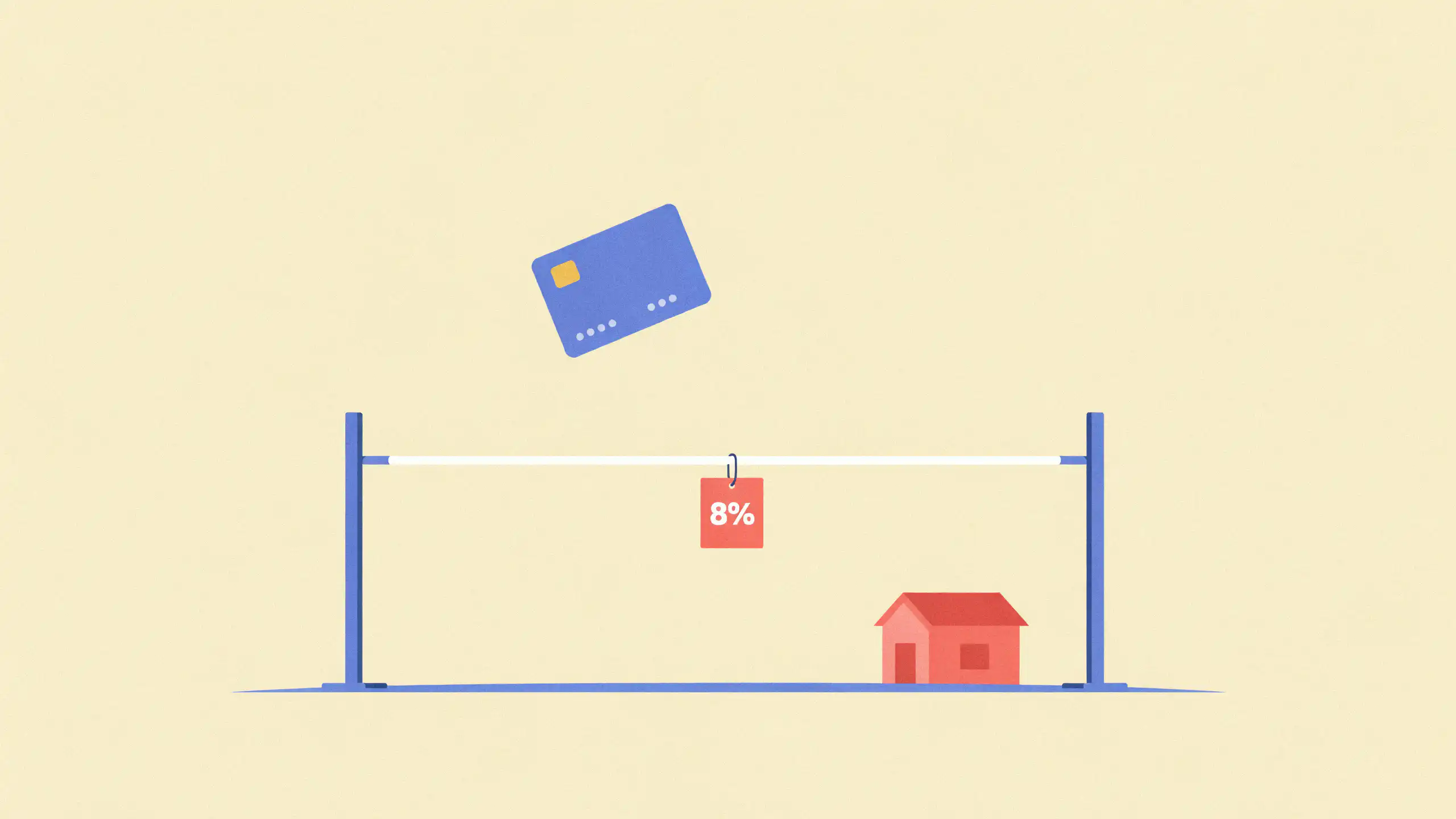

Before you weigh paying off debt against investing, collect your full 401(k) match. Then let each debt’s after-tax interest rate decide. Pay off any debt charging more than about 8% first, invest while you pay debt under 4% on schedule, and split your extra cash when a rate lands in between.
The rate decides because paying down a balance is an investment with a known return. Every extra dollar you put toward a card charging 24% earns a guaranteed 24%, and unlike investment gains, that return is never taxed.
Investing comes with no such promise. U.S. stocks, measured by the S&P 500, have returned about 10% a year with dividends since 1928, according to NYU Stern data. But they’ve lost money in about one year out of four, including a 37% drop in 2008. So $300 a month toward that 24% card earns more than double the market’s 10% average, and that return can’t have a losing year.
That’s where the 8% and 4% lines come from. Above 8%, a guaranteed return comes within 2 points of the market’s 10% average or beats it outright, so investing isn’t worth the risk. Below 4%, investing usually comes out ahead, since the market’s 10% average is more than 6 points higher. In between, the call is close, so give a 7% car loan part of your extra cash and invest the rest.
Two steps come before either choice. Collect your full 401(k) match, since a match of 50 cents on the dollar is an instant 50% return. And keep a starter emergency fund, so a surprise bill doesn’t land on a card and undo your progress.
Then adjust for taxes. If you deduct the interest, as many student loan borrowers can and homeowners who itemize do, multiply the rate by 1 minus your tax bracket. In the 22% bracket, a 5% mortgage costs about 3.9% after the deduction, so it falls below the 4% line. Only $2,500 of student loan interest a year is deductible, so if you pay more, use the full rate.
Being debt-free has value of its own, too. If a debt between 4% and 8% weighs on you, give it more of your extra cash.
This test settles one step of the financial order of operations, which sets where the rest of your money goes. Rerun it whenever a rate changes, such as when a 0% promotional rate ends.

Editorial & Advertiser Disclosure: The editorial content on this page is not provided, commissioned, reviewed, approved, or otherwise endorsed by any advertiser. Opinions expressed here are ours alone, not those of any advertiser. The offers that appear on this site are from companies that compensate us. That compensation may influence which products we cover and where and how they appear on a page – including the order in which they appear – but it does not influence our evaluations, ratings, or opinions. We do not include every company or offer available in the marketplace.
Related: