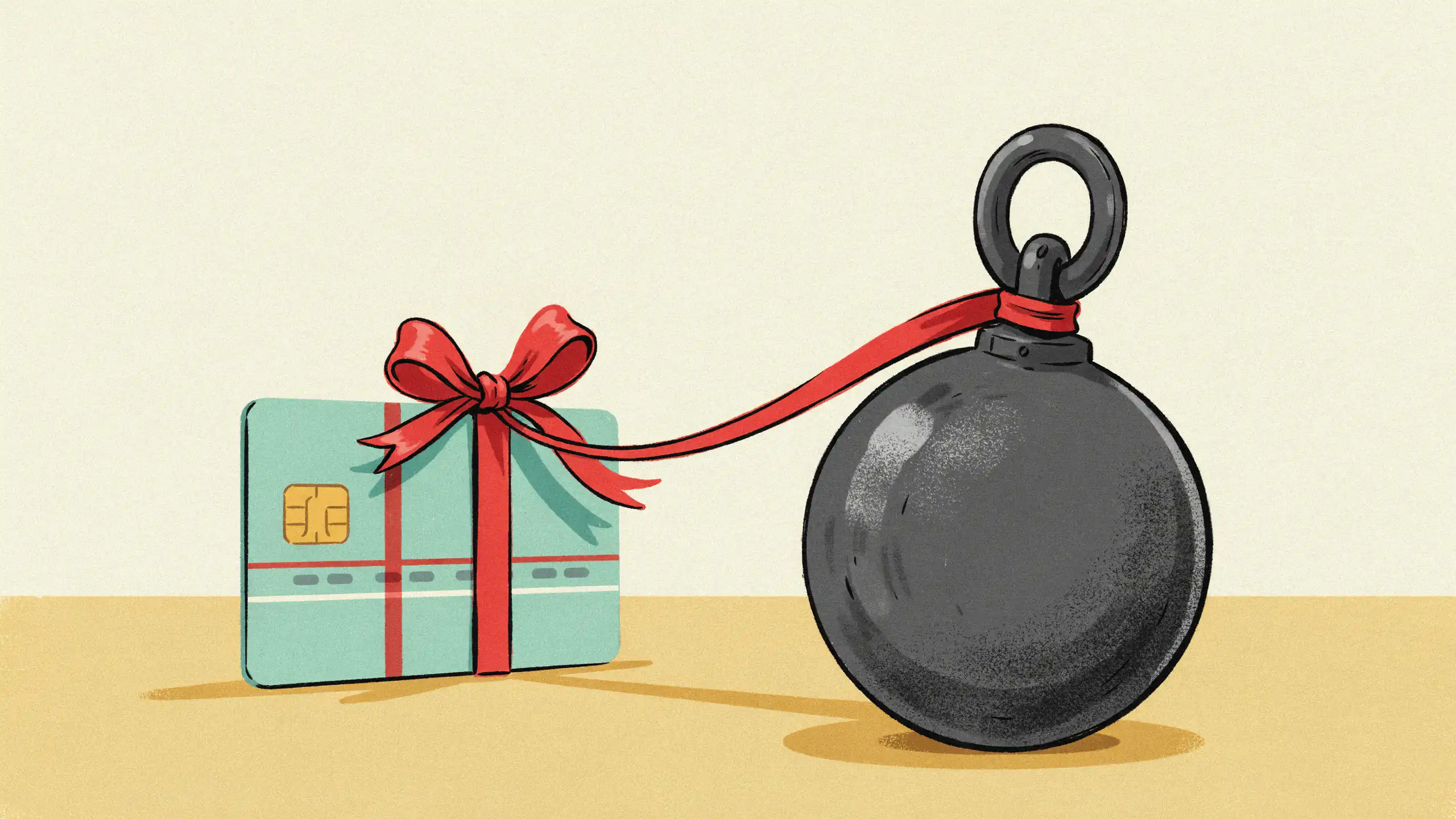

Your credit card is interest-free only for purchases you pay off in full by each due date. Leave part of a bill unpaid, take cash from it, or accept store financing, and the card becomes a loan, often at over 20% a year. Before you do any of those, check when interest starts and what fees apply.
Each mistake here turns a useful card into that loan, by starting interest sooner than you’d expect, keeping it running longer, or adding a fee on top. The everyday habits that keep a card free to use head off most of them, but not all.
At the 22% average rate the Federal Reserve reports for card accounts charged interest, a $2,000 balance works out to about $37 in interest a month.
Leaving part of the bill unpaid
1. Paying only the minimum each month
Your statement shows how long minimum-only payments would take to clear today’s balance. If the answer is years, your card is already a long-term loan.
Paying only your credit card’s minimum keeps the account current but barely reduces what you owe, since most of a typical minimum goes to interest. The minimum also shrinks as the balance falls, which adds years to the payoff. Pick a fixed monthly payment at least as large as this month’s minimum and stick to it.
Read more: A Typical Credit Card Minimum Is Mostly Interest - Pay a Fixed Amount Instead
2. Waiting out a missed payment
Late fees cost cardholders $17 billion in 2024, the Consumer Financial Protection Bureau found, and the fee is the least of what a missed payment can cost.
Missing your credit card’s minimum payment starts a clock. A late fee can hit right away, a credit report mark at 30 days, a penalty rate at 60, and collections near 180. Each stage is easier to stop than the one after it, so call your issuer before the due date and pay the missed minimum before day 30.
Read more: Can't Make Your Card's Minimum? Beat the 30-, 60-, and 180-Day Deadlines
3. Adding purchases to a balance you carry
This one involves no fee, no cash, and no new rate, only everyday spending on a card that already carries a balance.
If you carry a credit card balance most months, new purchases collect interest from the day you make them, and that interest soon costs more than any rewards they earn. Switch everyday spending to debit until the balance is gone, then go back to credit once you can pay in full every month.
Read more: Carrying a Card Balance? Switch to Debit Until It's Paid Off
4. Carrying a balance to build credit
Some cardholders leave part of each bill unpaid deliberately, because they believe lenders want to see a balance carried from month to month.
Paying credit card interest never raises your credit score. Scores see the balance on your statement and whether you paid on time, and newer ones count a balance you roll over against you. Use your card, then pay the full statement balance by the due date every month to build credit without paying interest.
Read more: Carrying a Credit Card Balance Does Not Help Your Credit Score
Getting cash from the card
5. Taking a cash advance
In a cash crunch, the quickest money in reach is often the credit line on the card already in your wallet.
A credit card cash advance is the costliest way to use your card. You pay a fee up front, usually 5%, and interest builds from day one, often at a higher rate than purchases. Money orders and some person-to-person transfers can count too, so keep your credit card out of anything that works like cash.
Read more: Never Take a Credit Card Cash Advance - The Fee and Interest Start That Day
6. Writing the checks your issuer mails
These checks look most useful for a bill that won’t take a card, such as rent paid to a landlord or a contractor’s invoice.
Convenience checks, the blank checks your card issuer mails you, draw on your credit line. Unless they carry a promotional rate, most are treated as cash advances, with a 3% to 5% fee and interest from day one, often at a higher rate than purchases. Read the rate table printed with them before you write one, and shred the rest.
Read more: Credit Card Convenience Checks Are Usually Cash Advances - Read the Rate Table First
Deals and add-ons
7. Financing a purchase with deferred interest
Store credit cards usually carry this offer, on purchases that range from furniture and appliances to dental work.
A “no interest if paid in full” offer means deferred interest, not a true 0% rate. Interest builds from the purchase date, and if any balance is left when the promotion ends, you owe all of it. Divide what you owe by one month fewer than the promotion length and autopay that amount.
Read more: Deferred Interest Isn't 0% APR - Leave Any Balance and Owe All the Back Interest
8. Buying payment protection for your card
Credit One Bank’s plan, for one, charges 96 cents a month for every $100 you owe, which works out to more than 11% of the balance a year, on top of interest.
Credit card payment protection charges a monthly fee on your balance for limited help after a layoff, disability, or death. Turn it down, and cancel it if it’s already on your statement. If your income drops, ask your issuer whether you qualify for a hardship program. It’s free, but it usually lowers your payment rather than making it for you.
Read more: Skip Credit Card Payment Protection Plans - The Fee Buys Narrow Coverage
9. Borrowing at 0% to earn savings interest
It’s pitched online as a way to make money from a card’s 0% offer, so check the math before you try it.
Balance transfer arbitrage means borrowing at 0% to park the cash in high-yield savings. The 3% to 5% transfer fee and income tax take most or all of the interest, and anything owed when the 0% ends gets the card’s regular rate, often over 20%. Pass on it and save your 0% offers for high-interest card debt.
Read more: 0% Balance Transfer Arbitrage Barely Pays or Loses After Fees and Taxes - Skip It
Whatever the mistake, its cost comes from a balance left for interest to build on or from a fee or higher rate of its own. Keep cash advances and paid add-ons off your card, and pay this month’s statement in full or set a fixed payment no smaller than its minimum.

Editorial & Advertiser Disclosure: The editorial content on this page is not provided, commissioned, reviewed, approved, or otherwise endorsed by any advertiser. Opinions expressed here are ours alone, not those of any advertiser. The offers that appear on this site are from companies that compensate us. That compensation may influence which products we cover and where and how they appear on a page – including the order in which they appear – but it does not influence our evaluations, ratings, or opinions. We do not include every company or offer available in the marketplace.
Related: