
While many people may not agree on musical tastes and favorite instruments, I think it’s safe to say that most still have a strong affinity for music, in some capacity – even if it’s just browsing free music listening and sharing websites.
It’s human nature to enjoy sounds coming together harmoniously, and further, music is actually good for you. Learning to express yourself musically can increase brain development, improve memorization, develop fine motor skills, and enhance problem solving skills. Music benefits the young and old alike.
However, music lessons can be extremely expensive, especially if you’re eyeing private lessons at an established school. Learning how to play an instrument doesn’t have to cost an arm and a leg. And to prove it, I’ve come up with 9 ways to save money on music lessons.
1. Barter Services with Musicians
I have a friend who is an electrician who has been able to score sweet deals by bartering his electrical skills for something in exchange. He recently got a week at a condo at the beach for about 8 hours worth of electrical work.
If you have a marketable skill, such as sewing, lawn care, or computer work, try to find a music teacher who would be willing to exchange lessons for your services. This type of arrangement works for the benefit of both parties.
2. Take A Group Lesson
You can save a ton of money by taking a group class instead of a private one-on-one lesson. Many community colleges offer basic music classes as leisure courses, which are available to anyone and does not count towards college credit. I have taken both guitar lessons and golf lessons using this method, and not only did I learn something, I also had a lot of fun. These courses can range from $30 to $60 for about 6 sessions.
3. Take Lessons Every Other Week
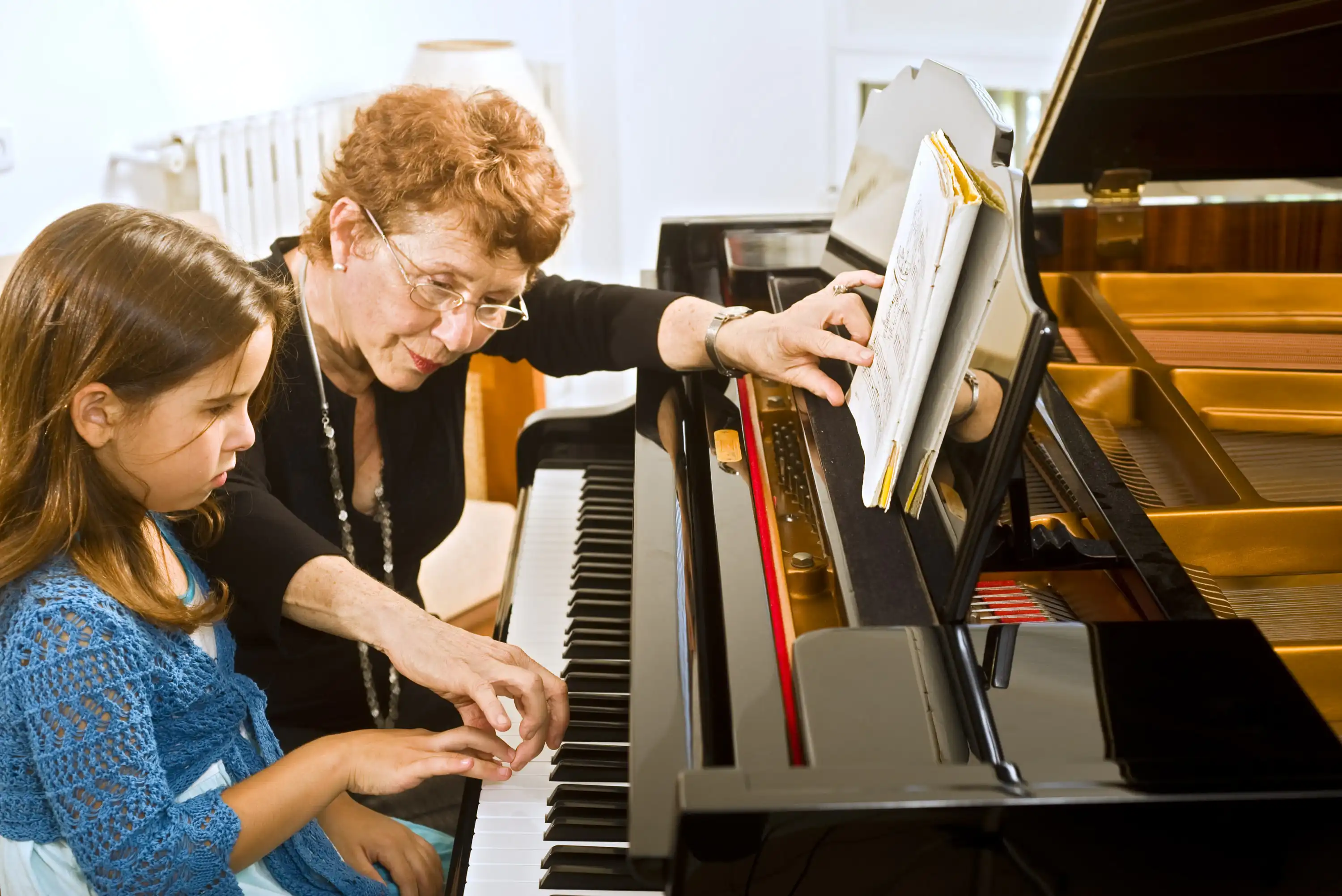
I took piano lessons once a week for years. Back in the day, my parents paid $12.50 per 30 minute lesson. That amounted to $650 per year. Had I taken lessons every other week, the cost would have been $325. Piano lessons now are more expensive than they were 20 years ago, so the savings on this would be even greater. Even though getting in practice every week is ideal for learning a new instrument, you can always use the off weeks to practice memorizing scales or individual pieces of music.
4. Utilize Your Library
Materials for lessons are an additional expense to the lessons themselves. Work with your instructor to see if she will let you choose your own materials. Check online and at your local library to see if you can get free materials. Another great resource is Internet Archive, which is one of the largest online libraries. You can also find a lot of used sheet music on eBay.
5. Buy Used Instruments
If you or your child are beginners, there is no need to buy brand new instruments before knowing whether or not you even enjoy playing. Used instruments can be just as good, if they were well cared for by previous owners. Utilize eBay, Craigslist, and Amazon to see if you can find a good, used instrument for a discount. Also, keep in mind that if musicians are selling their instruments, there is a chance they will sell you their materials and sheet music as well!
6. Hire A Young Person
Chances are, the older the instructor, the more experienced he is and the more he is able to charge. Try to hire a younger instructor, perhaps a college student. Make sure that he has experience teaching, in addition to musical abilities. Just because someone is able to play an instrument well doesn’t mean he also has the ability to teach it well.
7. Negotiate The Price
Music lesson prices are not set in stone. Shop around and see if you can get instructors to come down on price by negotiating a better deal. The worst that can happen is that they will say no, so go ahead and ask.
8. Self-Teach
If you or your child is self-disciplined, perhaps you want to try self-teaching. There are many resources available for those who want to learn to sing or play a musical instrument. Many of these resources can be found on the web and even on YouTube. Although for most people this is a difficult route, there are others who learn best by self-teaching.
9. Practice, Practice, Practice!
This is absolutely the best way to save money on music lessons. If you do not practice what you learn in your lessons, you will not advance in your abilities. The more you practice, and the better you get, the more valuable your lessons become. It’s not just about getting inexpensive lessons, it’s also about getting the most value for your money.
Final Word
While some of these methods may not work for all, there are always ways to cut costs when pursuing something that you really love. Whether it’s bartering for someone else’s services, taking a group lesson, or enlisting the help of a university student, there are tons of options for getting music lessons on the cheap.
Have you gotten discounted music lessons before? What are some of the best ways in which you learned a musical instrument?

Editorial & Advertiser Disclosure: The editorial content on this page is not provided, commissioned, reviewed, approved, or otherwise endorsed by any advertiser. Opinions expressed here are ours alone, not those of any advertiser. The offers that appear on this site are from companies that compensate us. That compensation may influence which products we cover and where and how they appear on a page – including the order in which they appear – but it does not influence our evaluations, ratings, or opinions. We do not include every company or offer available in the marketplace.
Related: