
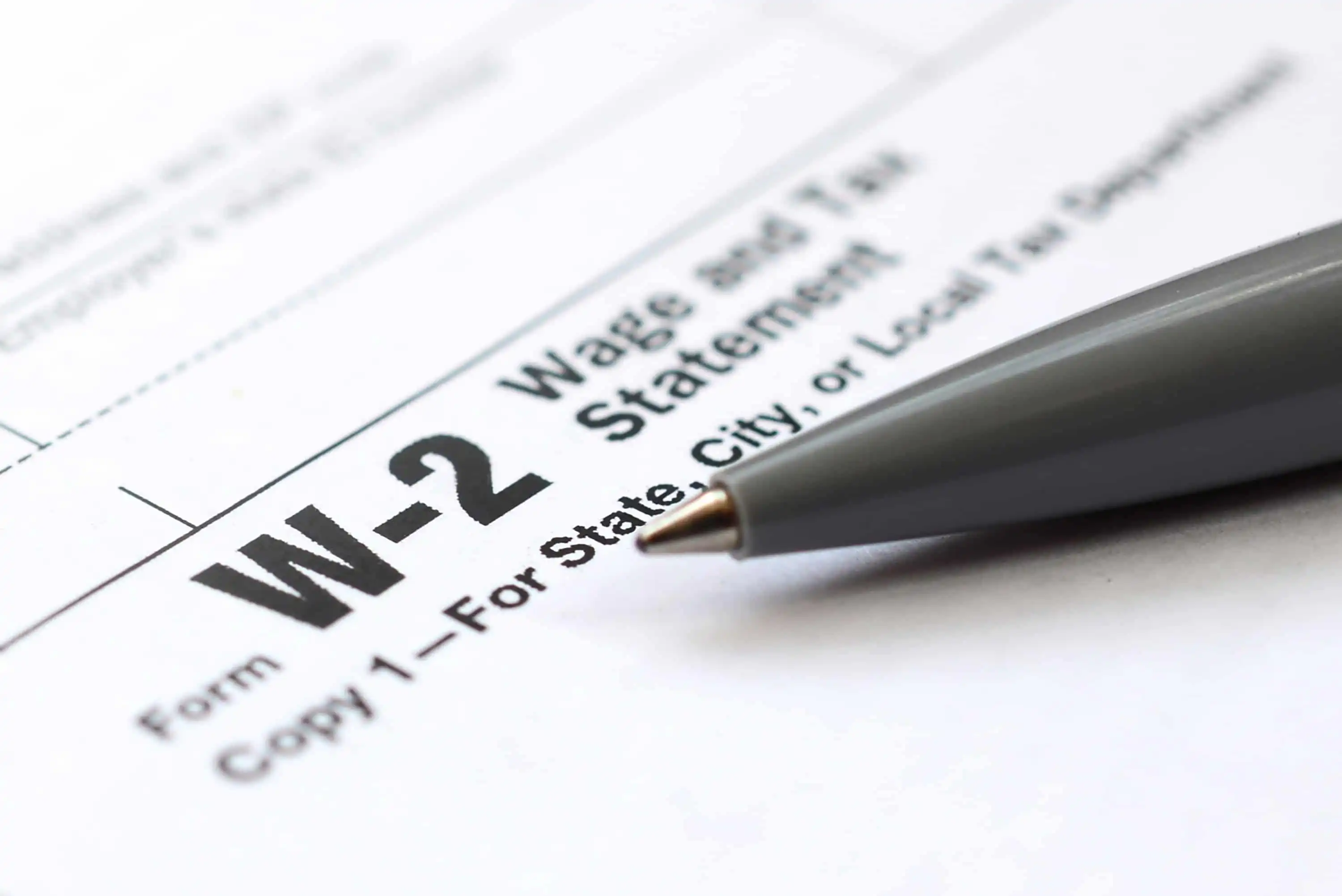
When tax season is in full swing, you’re probably dealing with multiple tax forms. If you’re an employee, one of those forms is Form W-2, Wage and Tax Statement.
An employer issues Form W-2 to an employee and sends a copy to the IRS. It shows your total wages earned as well as the income and payroll taxes your employer withheld. But those aren’t the only numbers on Form W-2.
Your W-2 has four sections in Box 12 labeled 12a, 12b, 12c, and 12d. These lowercase letters don’t mean anything. They just give your employer space to provide more information you need to prepare your tax return. But each amount entered in Box 12 also has an uppercase code that stands for something.
If you’re using tax preparation software from a company like H&R Block or TaxAct, the software prompts you to enter any amounts found in Box 12. But whether you prepare your return on your own or hire a qualified professional tax preparer, it’s critical you have a basic understanding of what the form says and how it impacts your tax return.
Form W-2 Box 12 Codes
These are the uppercase codes you might see in Box 12 of your W-2 as well as what each of them means.
A
Any uncollected Social Security tax or Railroad Retirement Tax Act (RRTA) tax on tips. Include this amount in your total tax liability on Schedule 2, which you file with your Form 1040.
B
Any uncollected Medicare tax on tips. This also goes into your total tax liability on Schedule 2.
C
If you had group term life insurance through your workplace, the premiums for any value over $50,000 become taxable income to you and are included here. They’re also included in the taxable wages shown in Boxes 1 and 3 of your W-2, so you don’t need to add them to those amounts.
D
Elective deferrals to a 401(k) or SIMPLE 401(k) retirement plan.
E
Contributions to a 403(b) retirement plan.
F
Contributions to a SEP IRA retirement plan.
G
Contributions you and your employer made to a 457(b) retirement plan.
H
Contributions to a 501(c) tax-exempt plan.
J
Nontaxable sick pay. This is informational only — it doesn’t affect your taxable income.
K
20% excise tax on excess golden parachute payments.
L
Employee business expense reimbursements. These aren’t taxable.
M
Uncollected Social Security tax or RRTA tax on the premium value of taxable group term life insurance over $50,000 for former employees.
N
Uncollected Medicare tax on the taxable cost of group term life insurance over $50,000 for former employees.
P
Reimbursements for job relocation moving expenses paid directly to a member of the U.S. Armed Forces and not included in boxes 1, 3, or 5.
Q
Nontaxable combat pay. This isn’t subject to tax, but you can use it to calculate your earned income credit if it helps.
R
Employer contributions to an Archer medical savings account (MSA). These aren’t common anymore, as most people use a health savings account (HSA) to save for out-of-pocket medical expenses. If you do have an Archer MSA, use this number to complete Form 8853.
S
Employee contributions to a SIMPLE retirement plan.
T
Any adoption benefits paid to you by your employer. Use Form 8839 to calculate any taxable and nontaxable amounts.
V
Income from exercising nonstatutory stock options.
W
Employer contributions to your HSA. You must report this amount on Form 8889.
Y
Salary deferrals under a 409A nonqualified deferred compensation plan.
Z
Income received under a nonqualified deferred compensation plan that fails to satisfy Section 409A. Your wages reported in Box 1 of Form W-2 also includes this amount.
AA
Designated contributions to a Roth 401(k) retirement plan.
BB
Designated contributions to a Roth 403(b) retirement plan.
CC
This box code is for employer use only.
DD
Cost of employer-sponsored health care. This amount is not taxable.
EE
Designated Roth contributions to a governmental 457(b) retirement plan.
FF
Permitted benefits under a qualified small-employer health reimbursement arrangement.
GG
Income from qualified equity grants under Section 83(i).
HH
Aggregate deferrals under Section 83(i) elections as of the close of the calendar year.
Final Word
Most employees only see a few codes in Box 12. Two of the most common ones are Code D for contributions to a 401(k) plan and Code DD for the cost of employer-sponsored health care.
If your Box 12 has any strange codes or you don’t know why your employer reported certain amounts, check with your payroll department.

Editorial & Advertiser Disclosure: The editorial content on this website is not provided, commissioned, reviewed, approved, or otherwise endorsed by any advertiser. Opinions expressed are ours alone, not those of any advertiser. The offers that appear are from companies from which we may receive compensation. However, this compensation does not impact where and how these companies are mentioned on the site. We do not include all companies or all available offers in the marketplace.
Related: